
How to deduct your car as self-employed (autónomo): VAT and income tax (IRPF)


 5. November, 2026
How you deduct a car in Spain depends on the tax. In personal income tax (IRPF), the vehicle must be used exclusively for your business; in VAT (IVA), the law presumes 50% business use. Hacienda (the Spanish Tax Agency) lets you deduct 100% of the VAT and of the IRPF expense if you prove exclusive use. With mixed use, you deduct 50% of the VAT (or more, if you prove higher business use) and nothing in IRPF.
Can you deduct your car as an autónomo in Spain? Short answer and legal framework
Yes. A self-employed worker (autónomo) can deduct a car as an autónomo in Spain when the vehicle is assigned to the business activity, whether commercial or professional. That includes knowing how to deduct fuel as an autónomo correctly. The deduction works in two different taxes, IRPF and VAT, and each one follows its own rules.
The law and Hacienda's criteria differ for VAT and for IRPF. If Hacienda finds an incorrect deduction during a tax review, it requires you to correct it with late-payment interest and may impose a penalty.
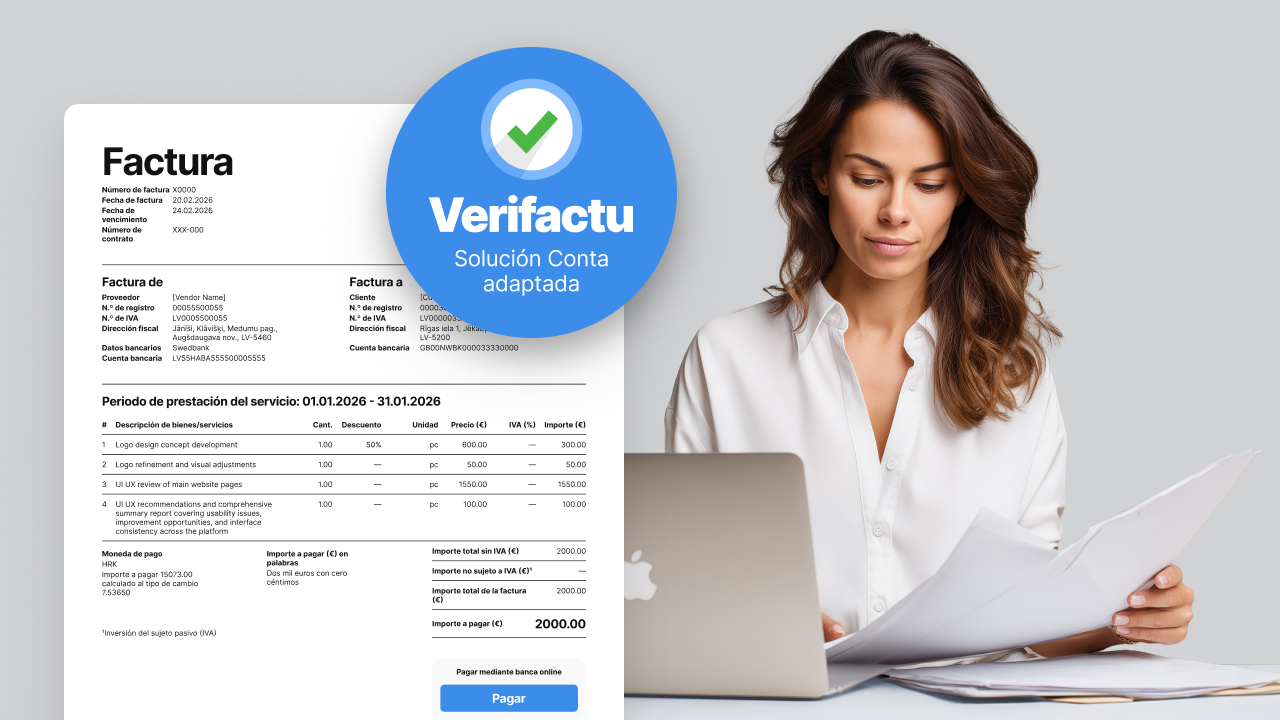
Conta is an invoicing program and accounting software for autónomos in Spain that covers everything from issuing invoices to managing expenses and preparing tax returns. It helps you keep an orderly record of every expense linked to your car.
Autónomo car expenses in Spain: which taxes allow the deduction?
The short answer: both, but under different conditions. IRPF requires the vehicle to be used exclusively for the business. VAT allows a partial deduction with mixed use.
This table sums up the key differences:
| Tax | General rule | Exclusive business use | Mixed use |
|---|---|---|---|
| IRPF | Deductible only with exclusive business use | 100% deductible | Not deductible |
| VAT (IVA) | 50% business use presumed | 100% deductible | 50% deductible (more, if you prove higher business use) |
What does assigning the car to your business mean?
Assigning the car means using it to carry out your business activity. In IRPF, that use has to be exclusive; in VAT, the law presumes 50% and accepts a higher percentage if you can prove it. Many autónomos use their vehicle for business purposes, and that use has to be proven to Hacienda with documents.
To deduct your autónomo car expenses in Spain correctly, record every business use, following the guidelines on Hacienda proof of car business use. Conta lets you classify these expenses within your general accounting and keep track of your deductible expenses as an autónomo in Spain.
The legal framework requires a clear separation between business and personal use. Without it, Hacienda rejects the IRPF deduction. In VAT, the general rule sets the deduction at 50% for mixed use, unless you prove higher business use.
Deducting the car in VAT: the general 50% rule
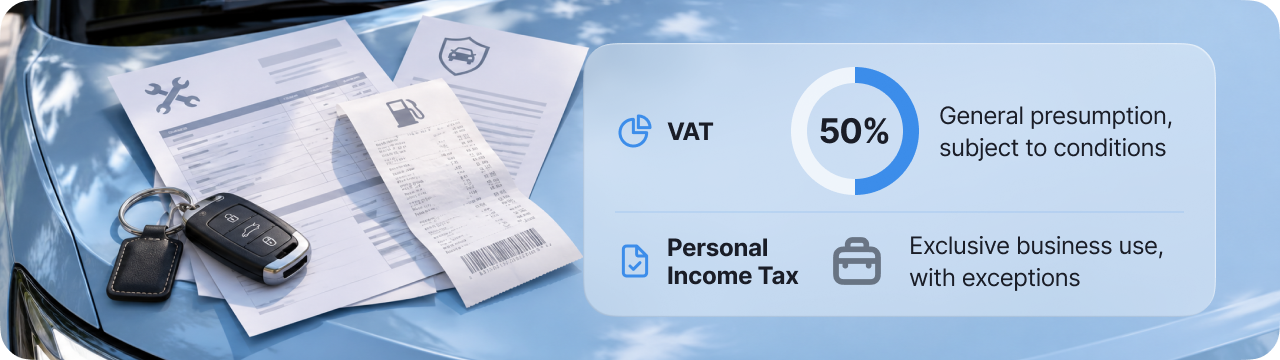
To deduct a car as an autónomo in Spain in VAT (IVA), there is a clear general rule. The Tax Agency (Agencia Tributaria) presumes 50% business use, under article 95 of the VAT Law (Ley del IVA). This presumption applies to passenger cars and their trailers, mopeds and motorcycles, and lets you deduct half of the VAT paid on the purchase and on the running costs of the vehicle. The presumption can be rebutted: you can deduct more if you prove higher business use.
There is no automatic middle ground. Apply the 50% VAT car deduction for autónomos as your starting point in each quarterly return, and check separately how to deduct car expenses in IRPF as an autónomo. Article 95 of the VAT Law presumes 100% business use only in specific cases: mixed-use vehicles used to transport goods, vehicles used to transport passengers or for driving lessons in exchange for payment, vehicles used by manufacturers for testing, trials, demonstrations or sales promotion, vehicles used by sales representatives or commercial agents for their business trips, and vehicles used for security services. Outside those cases, to deduct more than 50% you have to prove the real business use.
50% VAT car deduction for autónomos: which car expenses are included?
The 50% rule covers the VAT on goods and services directly linked to the upkeep and use of the business vehicle. The list includes:
-
Fuel and lubricants bought during the quarter.
-
Garage repairs, tyre replacement and regular servicing.
-
Motorway tolls and paid parking, whether in regulated street zones (zona azul) or car parks.
-
The purchase of the car itself, whose VAT is deducted at 50% in the return for the period of purchase.
Car insurance is not on this list: insurance transactions are exempt from VAT (article 20.One.16 of the VAT Law), so the policy receipt has no VAT to deduct. It is, however, a deductible expense in IRPF when the vehicle is used exclusively for the business.
Every invoice must identify you as the recipient of the service. To deduct the VAT you need a full invoice (factura completa), or a simplified invoice (factura simplificada) that includes your tax ID (NIF), your address and the VAT amount shown separately. Conta lets you record every invoice you receive together with its receipt. Without solid documentation, Hacienda rejects the deduction in a later review.
How do you back up the 50% business use in a tax inspection?
Prepare your evidence file before any request arrives. Five steps structure this documentary defence:
-
Write an internal assignment document that states the 50% percentage and describes your business activity.
-
Keep all invoices for the purchase, fuel, repairs and insurance with your NIF clearly shown.
-
Keep a mileage log that separates business trips from private ones.
-
File the bank payment records that link each expense to your business account.
-
Keep the quarterly Modelo 303 (VAT return) forms where the 50% deducted VAT is shown.
A tax review without these elements turns a legitimate deduction into an adjustment with penalties. Autónomos who apply the 50% presumption correctly reduce their tax bill without taking unnecessary risks. With ticket and invoice scanning and your bank connected, Conta helps you build this paper trail from the very first expense.
Deducting the car in IRPF: why Hacienda requires 100% business use
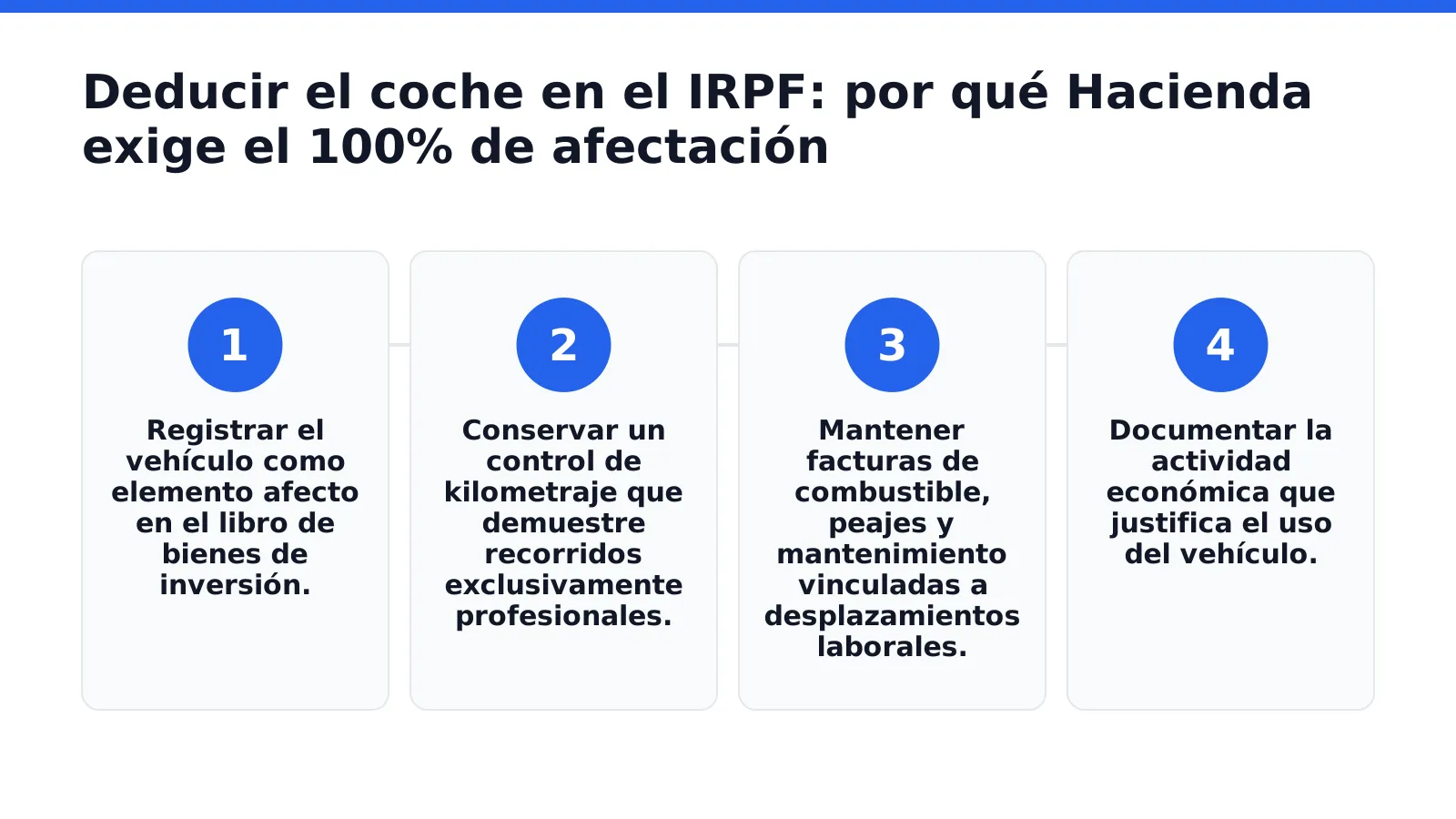
To deduct a car as an autónomo in Spain in IRPF, the rule is strict: the vehicle must be used exclusively for the business, unlike the 50% VAT car deduction, which allows mixed use. For a passenger car, any personal use, however small, removes the entire deduction in this tax. The Tax Agency applies a restrictive criterion in IRPF inspections, and the principle of indivisibility rules out partial assignment.
The difference with VAT is decisive. While VAT allows a 50% VAT car deduction for autónomos with mixed use, IRPF has no middle ground. If the car is used both for work and for private purposes, Hacienda does not allow you to deduct anything in IRPF. In short: mixed use only gives you 50% of the VAT and nothing in IRPF.
Deduct car expenses in IRPF as an autónomo: what does Hacienda require?
IRPF rules require the vehicle to be assigned exclusively to the business activity. For passenger cars, a single occasional personal trip invalidates the whole deduction. There are exceptions: the IRPF Regulation (article 22.4) covers cases such as mixed-use vehicles used to transport goods, and the Central Economic-Administrative Court (TEAC), in its decision of 24 June 2025 (RG 4214/2024), presumes that vans and mixed-use vehicles whose features point to business use are assigned to the business, unless Hacienda proves they are mainly used privately.
To prove exclusive business use, prepare solid documentation:
-
Record the vehicle as a business asset in your capital goods register (libro de bienes de inversión).
-
Keep a mileage log showing exclusively business trips.
-
Keep fuel, toll and maintenance invoices linked to work trips.
-
Document the business activity that justifies using the vehicle.
Can you deduct a mixed-use car in IRPF?
No. Deducting autónomo car expenses in Spain with mixed use in IRPF is not possible under Hacienda's current criterion. The ban on partial assignment means the vehicle is either fully assigned to the business or not at all. There is no intermediate percentage in IRPF, unlike in VAT.
This rigidity leads to significant tax losses. An autónomo who cannot document exclusive use loses the IRPF deduction for every expense linked to the vehicle. To deduct car expenses in IRPF as an autónomo, you therefore need a complete separation between business and personal use.
Which car expenses can an autónomo deduct and how to justify them
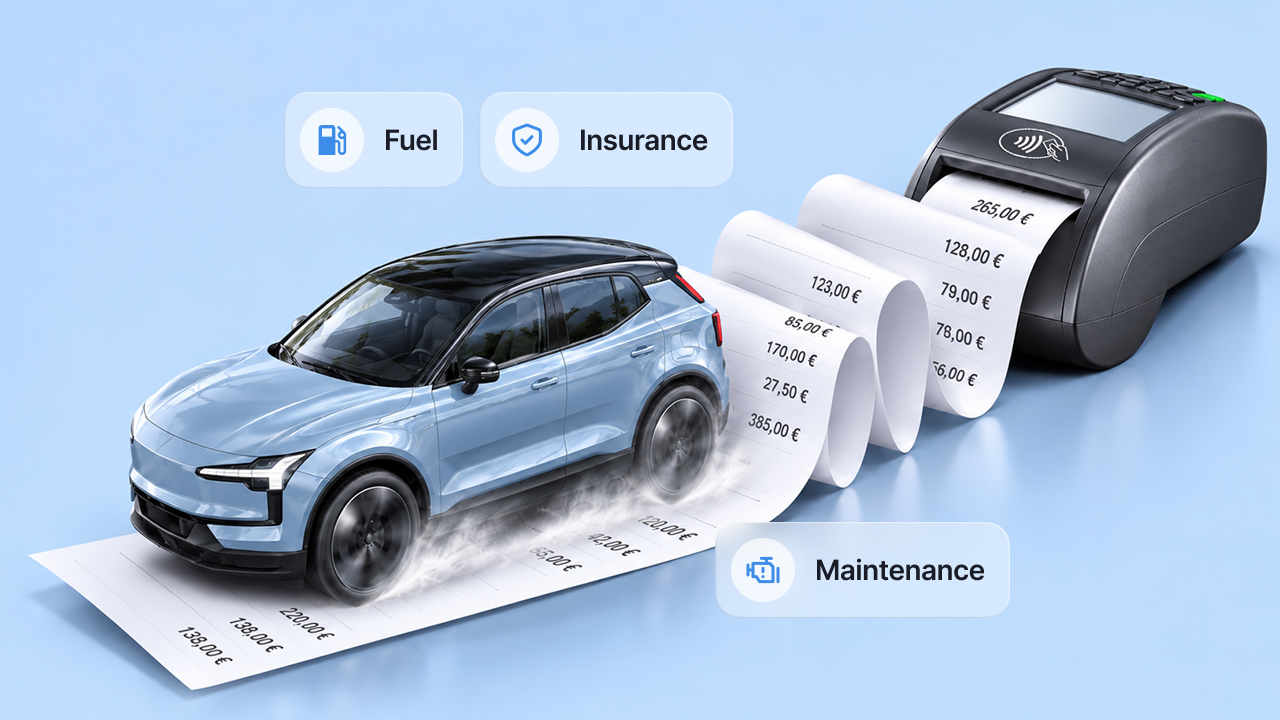
An autónomo can deduct the vehicle expenses that are strictly linked to their business activity. The deduction covers fuel, maintenance, insurance, the ITV (roadworthiness test), repairs, tolls and parking, as long as every payment is properly documented.
The rules require strong evidence. A mistake in your documentation can lead to requests from the Tax Agency and to the adjustment of any expenses you cannot prove, with late-payment interest and a possible penalty. That is why careful records of every transaction are your first line of tax defence.
How to deduct fuel as an autónomo: invoices and receipts you need
The fuel deduction for autónomos follows a strict protocol. To deduct the VAT you need a full invoice issued in the name of the business owner, or a simplified invoice that includes your NIF, your address and the VAT amount shown separately. A till receipt that does not identify you does not allow you to deduct the VAT. Paying by card or another traceable bank method is not a legal requirement for the deduction, but it strengthens the proof that the expense is linked to your business.
Other running costs need their own specific documents:
-
Maintenance and repairs: a detailed invoice showing the registration number of the business vehicle.
-
Insurance and ITV: the insurance receipt and proof of payment of the ITV fee, both in your name.
-
Tolls and parking: an invoice with your details to deduct the VAT; a receipt that does not identify you only works as proof of the trip or parking linked to a business journey.
How do you record these expenses automatically without losing receipts?
The number of receipts creates a risk of losing them and making admin mistakes. Conta includes ticket and invoice scanning that digitises each receipt. It captures the data on the ticket, links it to the right expense and stores it for future tax reviews.
That automated paper trail makes the difference in an inspection. You keep an orderly archive of all your fuel, repair and toll invoices. Each expense is linked to its original receipt and to a verifiable bank payment, so you meet Hacienda's documentation requirements without filing paper by hand.
How to prove the business use of your vehicle to Hacienda
The Tax Agency requires strong documentary evidence before it accepts the deduction of car expenses in IRPF. Without that evidence, you lose the right to deduct every euro you declared. The most useful proof rests on three pillars that nobody can improvise after receiving a notice.
Spanish tax law places the burden of proof on whoever claims the deduction. For a passenger car, Hacienda does not need to prove private use: it is the autónomo who must prove that the car is used exclusively for the business. The exception is vans and mixed-use vehicles with business features, which the TEAC presumes are assigned to the business; in that case, it is Hacienda that must prove they are mainly used privately.
Hacienda proof of car business use: what do you need to justify the deduction?
The law does not set a closed list of evidence, but the most useful proof falls into three categories that must be kept up to date and consistent with each other. The 50% VAT car deduction for autónomos is presumed, but you need these same elements to deduct a higher percentage or to defend the deduction in a review.
-
Mileage log. A detailed record with the date, starting point, destination, kilometres driven and business reason for each trip. With your bank connected in Conta, fuel, toll and parking payments are recorded in your accounting, so you can match them with each trip.
-
Client calendar. Appointments, meetings and sales visits must match the trips you logged. Any inspector will cross-check both sources to spot inconsistencies.
-
Geolocation. Apps or digital records that place the vehicle at the locations you declared as business destinations make your calendar and mileage log more credible.
Consistency between these three elements is what separates an accepted deduction from an assessment with penalties. A manual fuel log without a calendar or other objective data behind it greatly weakens your evidence.
What have the TEAC and the Supreme Court established?
The Supreme Court (Tribunal Supremo), in its judgment of 13 June 2019 (appeal 1463/2017), confirmed that a passenger car is an indivisible asset and cannot be partially assigned to the business in IRPF: if it is also used for private needs, it is not assigned to the business. The TEAC, on the other hand, in its decision of 24 June 2025 (RG 4214/2024), relaxed the criterion for vans and mixed-use vehicles: if their features (body type, signage, conversion) point to business use, they are presumed to be assigned to the business, and Hacienda can only deny it by proving they are mainly used privately.
In any case, your own statement is not enough as proof. A mileage log becomes stronger when it is backed by toll invoices, parking receipts and client communications that confirm you were at a given place and time. With your bank connected, Conta matches each of these payments with your accounting, so you can build a solid evidence file before any request arrives.
Without this Hacienda proof of car business use, any deduction is worthless. Bank data linked to your accounting and a digital calendar strengthen your position if Hacienda adjusts your return.
Renting or buying: which option is better for deducting your car?
Renting (long-term car leasing) offers tax advantages over buying for autónomos in Spain. Monthly renting fees are deducted as a running expense, while a purchase has to be depreciated over several years. This difference completely changes an autónomo's tax planning.
Whether to deduct a car as an autónomo in Spain through renting or a purchase depends on the real use of the vehicle and the type of activity. Renting lets you allocate each monthly fee directly to the current tax year. Buying forces you to spread the cost using the official depreciation tables.
What tax advantages does renting have over buying?
Renting has a clear practical advantage: the monthly fees are deducted straight away. There is no large upfront payment to depreciate. In IRPF, the Tax Agency accepts these fees as a deductible expense when the vehicle is used exclusively for the business.
Buying gives you a slower deduction. You recover the investment for tax purposes through annual depreciation, which stretches over several years: in the simplified depreciation table, transport equipment has a maximum straight-line rate of 16% and a maximum period of 14 years, so depreciation takes at least just over six years.
What deduction limits apply to renting in IRPF and VAT?
Monthly renting fees have deduction limits in IRPF and VAT. In IRPF, Hacienda requires you to prove that the vehicle is used exclusively for your business. Any personal use, however small, removes the entire deduction in this tax.
In VAT, the general rule lets you apply the 50% VAT car deduction for autónomos to renting fees. 100% is only accepted in specific cases where full business use is proven. This asymmetry between the two taxes means you need rigorous records.
| Option | IRPF deduction | VAT deduction | Upfront cost |
|---|---|---|---|
| Renting | Monthly fees as an expense (only with exclusive business use) | 50% general rule, 100% with full business use | No large upfront payment |
| Purchase | Annual depreciation (maximum 16%; only with exclusive business use) | 50% general rule, 100% with full business use | High initial investment |
To deduct your car safely, keep full invoices and justify the link with your business. The guide to deductible expenses for autónomos explains the documents the Tax Agency requires for each type of expense.
Conta automates invoicing and helps you get paid faster. That frees up admin time you can put into growing your business. Keeping every renting fee in order also makes it easier to justify it to Hacienda.
How your car fits with the rest of your deductible expenses
An autónomo's tax picture has to be seen as a whole. No expense stands on its own. The deduction for your business vehicle is directly connected to other categories that Hacienda examines together during a review.
Remote-work and home expenses are the first link in this documentary chain. If you declare partial business use of your home, it has to be consistent with the trips that justify using the vehicle. Contradictions between the two can trigger requests from the Tax Agency. Conta's guide to deductible expenses for autónomos brings these connections together so your figures add up.
How are remote-work expenses related to the car deduction?
The link is direct: in a review, Hacienda can compare both items. If you deduct home utilities because you work from home, you do a large part of your work there, so you must be able to explain which business trips justify using the vehicle. In IRPF there is no "share" of business use for the car: it is either used exclusively for the business or it is not. Consistency between both declarations protects you in an inspection.
Why does the type of receipt matter when deducting expenses?
Your documentation determines whether the deduction is valid. Full invoices contain all the tax details required by law. Simplified receipts do not allow you to deduct the VAT unless they include the recipient's NIF and address and the VAT amount shown separately. A petrol station receipt without your NIF is not enough in a review. Conta builds these differences into the way it records expenses, so every receipt does its job as proof.
Your tax affairs work as a connected system. Every decision about the vehicle affects the other items, and every receipt you keep determines how solid the whole picture is.
Avoid tax requests and make the most of your deductions with Conta
Conta calculates your VAT and IRPF from your own invoices and expenses and prepares your Modelo 303 (VAT) and Modelo 130 (IRPF) with their reports. You review them and file them yourself in the Tax Agency's online office (Sede Electrónica), without depending on anyone.
What does Conta do for you before each quarterly return?
An inspector can reject a deduction over a minor formal defect. With Conta, every invoice, receipt and bank payment is in one place, and your quarterly returns come from your own records. You don't need to know accounting: you see your figures clearly before you file.
How do you start risk-free with Conta?
You get 180 days free, no card and no commitment. Those six months let you check how Conta fits your real activity. With no upfront cost, you can try every feature at your own pace.
Making the most of your deductions with Conta follows four steps:
-
Start free with 180 days and no bank card. Your account is ready straight away, with every feature available.
-
Connect your bank. Every fuel, maintenance or toll payment comes into your accounting so you can classify it in the right tax category.
-
Review the forms Conta prepares before each return. Your Modelo 303 and Modelo 130 come with their reports, so you can see where every figure comes from.
-
File your quarterly returns with your documents in order. You file them in the Sede Electrónica, and Conta keeps your invoices and receipts stored for any future request.
Conclusion
How you deduct your car ultimately depends on how consistent your records are across all your expenses. Apply the 50% VAT rule or prove full business use, keep every invoice with all the required tax details, and make sure your remote-work expenses match your vehicle trips. With that structure, you file your quarterly returns fully prepared for any review by Hacienda.
Start free: 180 days free, no card, no commitment.