
Can you be salaried and self-employed at the same time?


 14. October, 2025

Yes, in Spain you can be self-employed and salaried at the same time. This situation is known as pluriactivity.
This means that a person can work as an employee (that is, with an employment contract and registered in the General Social Security Regime) and, at the same time, carry out a self-employed activity (registered in the Special Regime for Self-Employed Workers, or RETA).
Some key points
- Contribution: you will pay contributions in both regimes, but there are specific reductions or bonuses for those who register as self-employed while already registered in the General Regime.
- Bonus for multiple activities: may imply a reduction in the contribution base of self-employed workers during the first years, depending on the type of work you have as an employee.
- Income declaration: you must declare the income from both jobs, both those from salaried employment and those obtained from self-employment.
- Job compatibility: your contract as an employee must not prohibit the performance of other activities (for example, you cannot work as a freelancer in direct competition with your company if the contract or agreement prohibits it).
In any case, those who combine both conditions can benefit from certain bonuses and also enjoy improvements in their benefits, such as those related to temporary disability or unemployment.
What procedures must be carried out to work as self-employed and salaried at the same time?
There is no specific procedure to make both situations compatible. Actually, the steps to follow are quite simple:
- Register with the AEAT: you must register with the Tax Agency using form 036, indicating the IAE heading(s) that correspond to your activity.
- Registration in the RETA: you have to register in the Special Regime for Self-Employed Workers.
- In addition, the company where you work will be responsible for keeping you registered in the General Social Security Regime, so it is not necessary to carry out any additional procedures in that regard.
Tax obligations in multiple activities
Some aspects may vary depending on your IAE (Economic Activities Tax) heading, that is, depending on the type of activity you carry out as a self-employed person and your tax regime:
-
1. IRPF (Personal Income Tax)
- The income from your salaried work is declared as income from work.
- The income from your self-employed activity is declared as income from economic activities.
- Quarterly you must submit form 130 (individual income tax payments), unless more than 70% of your income is subject to withholding.
- In the annual income tax return, both types of income are added together.
- If your activity is not exempt from VAT, you must issue invoices with VAT, present form 303 (quarterly declaration) and form 390 (annual summary).
- If your activity is exempt from VAT (for example, certain health, educational or financial activities), you do not have to submit it.
- Even if you work as an employee, you will have to pay your self-employed fee monthly, with the contribution base you choose (and with the aforementioned reductions if applicable).
- Enter the withholdings that have been applied to you in an expense invoice (form 111) or in the rental of an office or office (form 115).
You must keep a record of:
- Invoices issued.
- Invoices received (deductible expenses).
- Investment assets, if any.
- The income from your salaried work is declared as income from work.
Bonuses for multiple activities
Contributions are temporarily reduced: if the employee contract is full-time, as a self-employed person you can opt for the flat rate (if the requirements are met) or for the special multi-activity bonus, which represents a 50% reduction in the minimum contribution base for 18 months, and 75% in the following 18 months.
If the contract is part-time, this special bonus is 75% and 85% (in the same periods). If this is chosen, and the other is being charged, the first must be waived.
On the other hand, the flat rate for self-employed workers allows new entrants to benefit from a reduced monthly fee (€80/month) for the first 12 months, extendable up to 24 months if the minimum interprofessional salary (SMI) is not exceeded.
The decision between the multi-activity bonus or the flat rate depends on each case. We encourage you to do your numbers before deciding on one or the other.
Important
When starting an economic activity, it is necessary to take into account the obligation to carry out accounting independently, as well as the record of income and expenses, in order to carry out an accurate calculation of taxes.
Doing it on your own may seem complicated, especially if it is your first time. It is important to do it with great precision to reduce the tax base of the income tax and save resources so necessary for the development of economic activity.
Doubts about the accuracy of tax data and calculations can be minimized with the help of proper accounting software.
Easier accounting management with Conta.es
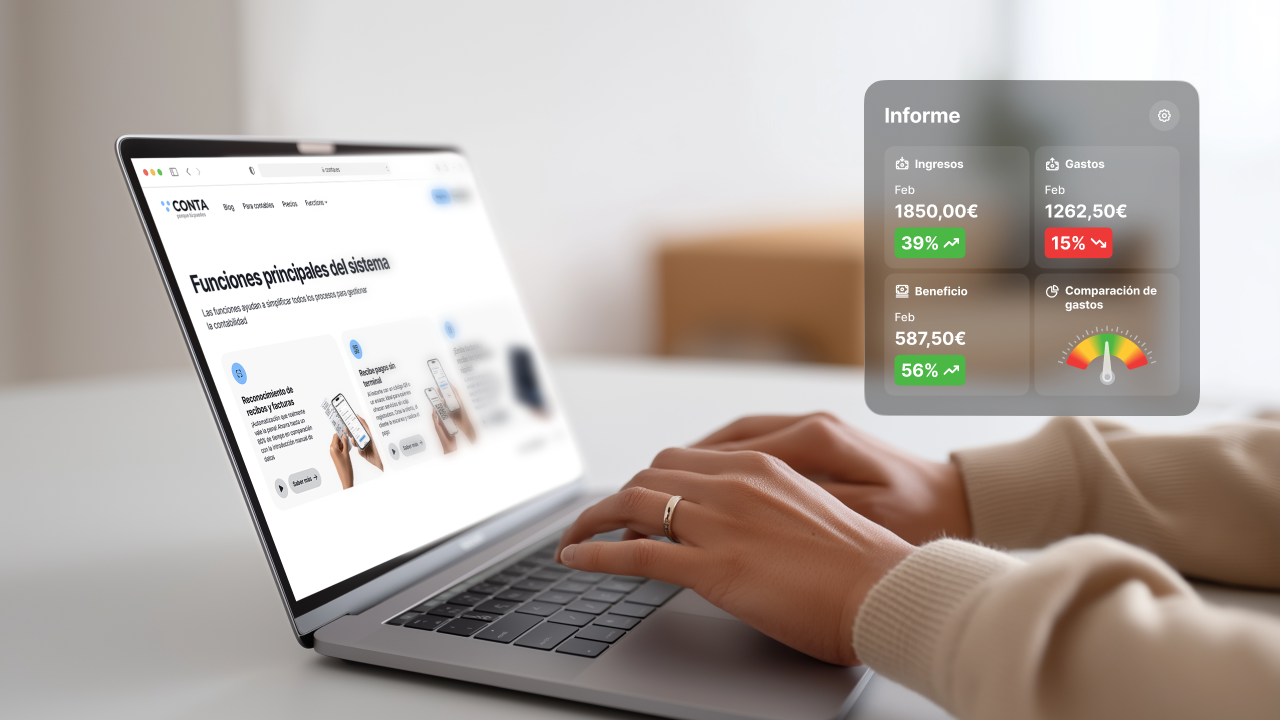
If you are looking for such a program, try Conta.es! The Conta.es system makes accounting management simpler, since everything complex - calculating taxes, filling out the income and expense book and preparing reports - is done automatically.
All the user needs to do is diligently record income and expenses and upload the data into the system.
No prior accounting knowledge is required to use Conta.es - try it and see for yourself! Register and enjoy the first 7 days free.