
Deductible expenses for self-employed workers in Spain


 22. January, 2026
Deductible expenses for self-employed individuals in Spain: what you can deduct and what you cannot
One of the greatest tax benefits of being self-employed in Spain is the ability to deduct expenses related to your professional activity. However, it is also one of the areas where the most mistakes are made… and where the Tax Agency pays the closest attention.
In this article, we explain which expenses you can deduct, what requirements they must meet and what is best to avoid, with clear examples. For more complex cases, you will find links to our detailed guides.
When is an expense deductible?
For an expense to be deductible in IRPF and/or VAT, it must meet two key conditions:
- It must be necessary for your professional activity
- It must be used exclusively for that activity
Simply put:
If this expense is necessary to generate income from your economic activity, it is deductible.
If you are unsure whether it is personal or professional, the Tax Agency will likely question it as well.
Thinking like the Spanish Tax Agency is usually the best filter.
The invoice: the essential requirement
In most cases, without an invoice there is no deduction.
For an expense to be valid, you need a complete invoice that includes:
- Invoice number and date
- Issuer details (name, NIF/CIF, tax address)
- Clear description of the product or service
- Taxable base
- Applied VAT
With a proper invoice you will be able to:
- Deduct the expense in IRPF
- Deduct the input VAT
⚠️ Important: without a complete invoice you will never be able to deduct VAT, even if the expense is real.
Are there deductible expenses without an invoice?
Yes, but they are the exception, not the rule.
Some common expenses deductible in IRPF even without an invoice include:
- Self-employed contributions (Social Security)
- Professional associations
- Insurance
- Bank fees and commissions
In other cases (public transport, taxis, occasional tickets), it is always advisable to request an invoice whenever possible. A receipt may work in some cases for IRPF, but it is not a guarantee in the event of a tax review.
Main deductible expenses for a self-employed individual
Self-employed contributions
- 100% deductible in IRPF
- One of the easiest expenses to justify
Office or workplace
- Office or coworking rent: deductible if used exclusively for professional purposes
- Working from home: you can deduct part of the rent in proportion to the square meters used for your business activity, provided that the rental contract does not explicitly prohibit conducting economic activity at your home address. You can also deduct part of utility expenses (internet, electricity, water, gas) up to 30% of the proportion of square meters used for the activity relative to the total size of the home
Equipment and technology
- Computers, printers
- Software, licenses, digital tools
- Office supplies
Transport and vehicle
- Public transport, tolls, parking for professional reasons
- Vehicle: proportional deduction according to professional use for some economic activities
- (criteria regarding vehicles evolve and should be reviewed each year)
Meals and travel expenses
- Meals and accommodation for professional reasons
- With daily limits established by the Tax Agency
- Electronic payment and an invoice improve justification
Training
- Courses, books and training directly related to your activity
Professional services
- Accounting and tax advisory services
- Lawyers, consultants, marketing services
Insurance
- Professional insurance
- Private health insurance (with annual limits)
Depreciation and financial expenses
- Equipment, furniture
- Interest and commissions related to the activity
Employees
If you have employees:
- Salaries
- Social Security contributions
- Employee training and travel allowances
Can fuel be deducted?
Yes, but not always and it depends on several factors.
- IRPF: only if the vehicle is used 100% for the activity (very specific cases such as professional transport).
- VAT: normally you can deduct 50% of VAT on fuel if usage is mixed, and 100% in specific activities.
It is one of the most frequently reviewed expenses by the Tax Agency, so it should be well documented.
Expenses that are generally not deductible
- Personal expenses without a clear link to the activity
- Everyday clothing
- Fines and penalties
- Personal leisure
Key requirements for the Tax Agency to accept an expense
To avoid problems:
- The expense must be linked to your activity
- You must have a valid invoice or supporting document
- It must be correctly recorded in your accounting
- It must not be a personal expense
Conclusion
Deducting expenses as a self-employed individual is not about deducting everything, but about deducting correctly. Understanding what the Tax Agency accepts and keeping orderly accounting makes the difference between peace of mind and future problems.
In our detailed guides you will find:
- Updated limits
- Practical cases
You can find more information about deductible expenses in our help section here:
Control and compliance
Now that you know which expenses you can deduct as a self-employed individual and which you cannot, the next step is just as important as the first: keeping those expenses properly recorded, with invoices organized and ready for any Tax Agency review.
In day-to-day practice, many problems do not arise from a lack of knowledge of the regulations, but from not having information properly organized, not finding an invoice on time, or mixing personal and professional expenses. That is where a good tool makes the difference.
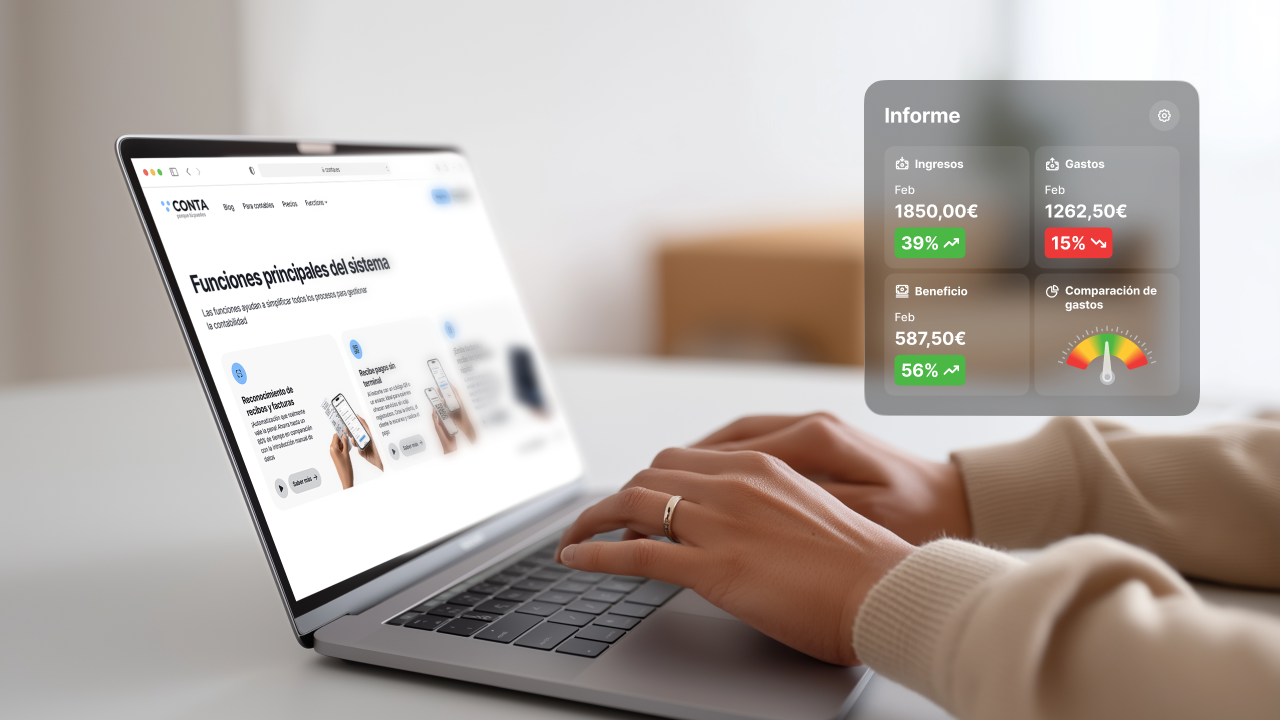
With Conta.es you can:
- Register your expenses easily and classify them correctly
- Attach and store your invoices in digital format
- Keep your accounting always ready for your taxes and for the Tax Agency
In this way, you not only comply with the regulations, but you also gain peace of mind, save time and reduce the risk of errors that can lead to requirements or penalties.
If you are self-employed and want to keep your deductible expenses under control from day one, you can start using Conta.es right now and manage your accounting easily and in compliance with Spanish regulations.
Sign up for free and start today