
Deductible expenses for self-employed workers: fully guide


 9. March, 2026

If you work as a self-employed professional in Spain, every euro you can legally deduct is a euro you do not pay in taxes. Deductible expenses are those costs directly related to your economic activity that you can subtract from your gross income to reduce what you ultimately pay in IRPF and VAT. This guide explains what you can deduct, how to substantiate it, and which mistakes to avoid for tax years 2024-2025 and the 2025 Income Tax campaign.
Introduction: why deductible expenses are key for a self-employed worker in Spain
A deductible expense is one that tax regulations allow you to subtract from your income to calculate how much you really have to pay to the Tax Agency. This directly affects your quarterly IRPF settlement (form 130), VAT (form 303) and your annual income tax return. For tax years 2024 and 2025, whose Income Tax campaign will be filed between April and June 2026, knowing your deductible expenses well makes the difference between overpaying or aligning your taxes with the reality of your business.
Let’s look at a simple numerical example: if you invoice €30,000 a year and have €8,000 of properly substantiated deductible expenses, your IRPF taxable base will not be €30,000 but €22,000. Depending on your income bracket, this can mean savings of several thousand euros in taxes.
But be careful: deducting expenses is not “paying less tax just because.” Only expenses that are necessary for your professional activity and that you can prove with proper documentation count. Spending more does not automatically benefit you; what benefits you is knowing which expenses you already have and which are truly deductible.
At Conta.es we help record and store all these expenses in the cloud. This is especially important because the Tax Agency can review your returns from previous years. If the Agencia Tributaria asks you for supporting documents within 1, 3 or even 5 years, you will be able to download all the documentation in seconds from your account.
What are deductible expenses for a self-employed worker (IRPF and VAT)
A deductible expense is one that is necessary to obtain income from your activity and that tax regulations allow you to subtract from the calculation base. The two fundamental laws are Law 35/2006 on IRPF (Personal Income Tax) and Law 37/1992 on VAT.
It is important to distinguish between two types of deduction:
- Expenses deductible for IRPF: they reduce your net income from the activity. You report them quarterly in form 130 and annually in your income tax return. For example, if you pay €200 a month in rent for a business premises, those €2,400 per year directly reduce your taxable profit.
- Expenses with deductible VAT: input VAT (what you pay on your purchases) is subtracted from output VAT (what you charge your clients) in the quarterly form 303 and the annual form 390. If you charge €2,100 in VAT to your clients and have paid €800 in VAT on your expenses, you only pay the difference (€1,300) to the Tax Agency.
The tax regime under which you are registered determines how these expenses apply. Under direct estimation (standard or simplified), real expenses are key because they directly reduce your base. Under modules (objective estimation), the tax due is fixed according to objective parameters and real expenses have little impact.
Most international professionals - IT developers, marketers, designers, consultants - are usually under simplified direct estimation, so knowing their deductible expenses well is essential to optimise their tax burden.
Requirements for an expense to be deductible before the Tax Agency
It is not enough to say “it is a business expense.” The Tax Agency applies three basic filters that every expense must pass to be deductible:
- Real link to the economic activity: the expense must be directly related to generating income from your professional activity. A laptop for a programmer: yes; a family holiday: no.
- Proper supporting documentation: you need a full invoice or a document accepted by regulations. A simplified restaurant receipt is not valid for deducting VAT; you need an invoice with your tax details.
- Correct accounting record: the expense must be recorded in your accounts and correspond to the tax year in which it accrued.
Even if you pay with a “business” card or from your business account, if the document does not meet the requirements, the Tax Agency can reject the deduction. The payment method does not replace the invoice.
In Conta.es you can upload invoices and receipts in PDF, JPG or PNG format. The system automatically extracts the data with OCR, but remember that you are still responsible for the information being correct and for keeping the originals if the Tax Agency requests them.
There are some exceptions where a full invoice is not required: the self-employed contribution (RETA), certain local taxes or bank commissions are substantiated with other documents that we will see later.

Common types of deductible expenses for self-employed workers in 2025
Before going into detail, here is the general map of expense categories a self-employed person can deduct:
- Self-employed contribution (RETA)
- Rent for business premises, office or part of a dwelling
- Utilities (electricity, water, gas, phone, internet). There are limitations if they relate to your home where you live
- Office supplies and equipment
- Vehicle, fuel and travel. Proportional deduction if it is assigned to the activity (only the professional-use portion).
- Travel, per diems and representation
- Training and professional tools
- Insurance linked to the activity
- External professional services (accounting firm, lawyers, marketing)
- Financial expenses (interest, commissions)
- Employees
Some expenses are deductible for both IRPF and VAT (for example, a software licence with a full invoice). Others only reduce IRPF but do not generate the right to deduct VAT because they do not bear VAT: insurance, bank commissions, RETA contributions.
The percentages and limits we mention in this guide (30% of utilities in a dwelling, €500 for health insurance, per diem caps) are based on the criteria in force in 2025, with reference to the Tax Agency’s doctrine and relevant case law.
In Conta.es each expense category can be recorded with its corresponding type, which makes it easier to automatically prepare forms 130, 303 and 390.
Basic deductible expenses that almost every self-employed worker should know
Regardless of your sector - IT, construction, beauty, teaching, consulting - there are “core” expenses that almost all self-employed workers have:
Social Security contribution (RETA)
It is 100% deductible for IRPF with no limit. If you pay €320 a month in self-employed contributions, that is €3,840 a year that directly reduces your net income. You do not need an invoice: bank statements or the receipt downloaded from Social Security are enough.
Accounting firm, advisory services and invoicing software
Accounting or tax advisory services are deductible as long as the invoice is in the self-employed person’s name. The same applies to accounting and invoicing software such as Conta.es: the subscription cost (for example, €9-29/month) is a deductible expense linked to your activity.
Office supplies and equipment
Stationery, ink, hard drives, computer peripherals, office furniture. For a programmer, a powerful laptop is clearly deductible. For a carpenter, power tools. For a photographer, SSD drives and card readers.
Bank commissions and payment platforms
Commissions charged by the bank for maintaining a business account, transfers or POS terminals are deductible for IRPF. PayPal, Stripe or payment gateway commissions are also deductible. They do not bear VAT (they are exempt), so they only reduce your IRPF base. Substantiate them with bank statements or receipts from the platform.
External professional services
Invoices from lawyers, freelance designers, copywriters, marketing consultants, subcontracted developers. Always with a full invoice including your tax details, the provider’s details, taxable base, VAT and withholding where applicable.
Premises, office or dwelling: rent, mortgage and utilities
The Tax Agency distinguishes three main scenarios depending on where you carry out your professional activity:
Business premises or office used exclusively for professional purposes
If you have premises dedicated 100% to your activity, you can fully deduct:
- Monthly rent
- Utilities: electricity, water, gas, internet
- Property tax (IBI) and waste collection fees
- Community charges
- Insurance for the premises
- Maintenance and repair expenses
It is important that you notify the Tax Agency of this premises on form 036 or 037 when you register or when you change location.
Coworking or office by the hour
Very common among designers, programmers and consultants who work remotely. The monthly coworking fee is fully deductible for both IRPF and VAT. You only need the invoice to be in your name with all tax details.
Main residence used as a place of work
This is the most complex and frequent case. If you work from home, you can deduct a proportional part of your expenses (as long as it is not prohibited in your rental agreement), but with specific rules:
- First, determine the percentage of assignment: what part of your home you use exclusively for the activity. For example, in an 80 m² flat where you use 12 m² as an office, the percentage is 15%.
- You must report this percentage to the Tax Agency in form 036/037.
- On that percentage, you can deduct 30% of utilities (electricity, water, gas, phone, internet).
Numerical example: you pay €150/month in utilities. Your assignment is 15%. The calculation is: €150 × 15% × 30% = €6.75/month deductible, i.e. around €81 per year in utilities alone.
In addition to the 30% of utilities, you can deduct the proportional part (15% in the example) of:
- Mortgage interest (not principal)
- Rent (with nuances; sometimes a separate contract is advisable)
- IBI
- Community charges
- Insurance linked to the dwelling
Phone, internet and digital tools
In 2025, practically any self-employed professional - IT, marketing, online teachers, psychologists, e-commerce - depends on communications and cloud tools.
Mobile phone
The safest recommendation is to have two separate lines: one personal and one professional. The Tax Agency often challenges phones with mixed use and, if you cannot clearly demonstrate professional assignment, it may reject the full deduction.
If you have only one line, document the percentage of professional use, but keep in mind that deductible VAT in these cases is limited to a maximum of 50%.
Landline and internet
Fibre and landline expenses are deductible when the contract is in the self-employed person’s name and linked to the premises or office. If you work from home, the 30% rule on the assignment percentage of the dwelling also applies.
Domains, hosting and SaaS
All these expenses are deductible for both IRPF and VAT:
- Domains and hosting for your website
- Software licences: Adobe Creative Cloud for designers, Figma for UX/UI, SEO tools for marketers
- CRM and email marketing platforms
- Project management tools
- Stock image subscriptions
Common mistakes to avoid:
- Not changing the phone line holder to your name as a self-employed person
- Mixing personal subscriptions (Netflix, Spotify) with professional licences in the same account
- Not requesting an invoice with full tax details for international services
Vehicle, fuel, tolls and parking
This is one of the most contentious points with the Tax Agency. Deductibility depends heavily on the type of activity you carry out.
Activities where the vehicle is essential
For hauliers, couriers, VTC drivers, travelling salespeople, installers or technicians who visit clients, vehicle use is clearly professional. In these cases, 100% of expenses are allowed:
- Fuel
- Maintenance and repairs
- Vehicle insurance
- Roadworthiness tests (ITV)
- Parking and tolls
- Renting or leasing
- Depreciation if owned
For other professionals
Consultants, IT developers, designers, psychologists, trainers… the situation is different. The Tax Agency’s usual criteria are:
- VAT: possibility of deducting up to 50% of input VAT on passenger cars
- IRPF: normally nothing, unless you can prove almost exclusive professional use (very difficult for passenger cars)
If you want to defend vehicle deduction, prepare documentation supporting professional use:
- Schedule of client visits with dates and addresses
- Contracts with clients in other cities
- Photos of the vehicle with your branding
- Tickets for alternative transport when you do not use the car (showing that the car is used specifically for work)
Parking and tolls
They are deductible when clearly linked to professional journeys. Keep invoices or tickets and link them in Conta.es to the corresponding client or project. This will allow you to justify the professional purpose if the Tax Agency asks years later.
Per diems, travel, trade fairs and representation
This section often raises many questions: can I deduct meals? hotels? flights? The Tax Agency is strict with documentation and applies specific daily limits.
Per diems for the self-employed person’s own meals
The updated daily limits for 2025 are:
Mandatory requirements:
- The expense must be incurred in a municipality different from your usual residence and place of work
- Payment by electronic means (card, transfer) or full invoice
- Documentation of the date, place and professional purpose of the trip
Meals with clients or suppliers
They must have a clear professional purpose: business meeting, negotiation, contract signing. It is advisable to note on the invoice or in your system the purpose, the client and the attendees. The Tax Agency often reviews the annual volume of these expenses in relation to your profit.
Business travel
Train, plane, bus, taxi and VTC tickets are deductible with:
- A full invoice with your tax details, or
- A ticket with identifying data plus proof of electronic payment
Low-cost airlines often issue only a purchase confirmation. Request a full invoice through their website or customer service.
Trade fairs, conferences and industry events
Registration, travel and accommodation are deductible if they are directly related to your activity:
- Programmer attending a tech conference in Barcelona
- Photographer travelling to a professional workshop in Malaga
- Marketer going to a digital advertising trade fair in Madrid
Use Conta.es to upload invoices for these trips immediately and link them to the event or client. That way, years later, you will be able to reconstruct the professional purpose with a single click.
Training, books, subscriptions and professional tools
Continuous training is particularly relevant for knowledge-based professions: IT, marketing, design, coaching, online teaching, psychology, consulting.
Courses and formal training
Courses, master’s degrees, workshops and webinars related to your sector or business management are deductible:
- Tax course for lawyers
- Coding bootcamp for developers
- Meta Ads training for marketers
- Professional certifications (AWS, Google, PMP…)
Specialist books and subscriptions
Both in print and electronic format, as long as they are linked to your activity:
- Technical books in your field
- Professional journals
- Digital subscriptions to specialist media
Educational platforms
Coursera, Udemy, Domestika, LinkedIn Learning… are deductible when the topics are clearly related to your professional activity. Download PDF receipts with tax details where possible.
Professional associations and mandatory membership fees
Fees to mandatory professional associations (lawyers, doctors, architects, engineers) are deductible expenses. Substantiate them with bank receipts or certificates from the association.
Examples by profession:
- Lawyer: annual legal conference + subscription to a legal database
- UX designer: user research course + prototyping software licence
- Therapist: training in new intervention techniques + clinical psychology books
Insurance, staff and other financial expenses
Many self-employed workers are unaware that they pay insurance and financial costs that can reduce their IRPF base.
Insurance linked to the activity
They are 100% deductible for IRPF:
- Professional liability insurance
- Comprehensive insurance for the premises
- Equipment insurance (cameras, computers, machinery)
Health insurance for the self-employed person
You can deduct premiums for private health insurance and sickness insurance up to a limit of €500 per person per year (self-employed person, spouse and children under 25). In the case of a recognised disability, the limit rises to €1,500. This deduction applies only to IRPF.
Life insurance associated with loans
If you have life insurance linked to financing your activity or to a mortgage for the premises, a portion may be deductible. This is a complex case that is best reviewed with an advisor.
Staff expenses
If you have employees, all of the following are deductible:
- Gross salaries
- Employer Social Security contributions
- Staff training
- Per diems and travel for employees
- Redundancy payments
For example, a small design studio with a part-time assistant can deduct their salary, employer Social Security contributions, materials they use and their training.
Loan and credit interest
Interest (not repaid principal) on loans used for the activity is deductible: financing for machinery, professional vehicles, premises refurbishment, equipment purchases.
In Conta.es you can record employees and staff expenses as a separate category, which makes it easier to see how much of your total costs relate to payroll and contributions.
Profession-specific expenses: practical examples
Each profession has its own particularities. Here is an indicative guide with concrete examples of deductible expenses by sector:
IT self-employed workers (developers, DevOps, tech consultants)
Clearly deductible expenses:
- Powerful laptops and high-resolution monitors
- Software licences and development tools
- Servers, hosting and cloud services (AWS, Google Cloud, Azure)
- Git hosting (GitHub, GitLab)
- Monitoring and debugging tools
- Coworking
- Travel to tech events and conferences
Borderline expense: €1,500 gaming chair → better a clearly professional ergonomic office chair.
Graphic designers, UX/UI designers and creatives
Clearly deductible expenses:
- Adobe Creative Cloud suite
- Graphic tablets (Wacom, iPad Pro with Pencil)
- Licensed stock images and fonts
- Proof prints and mock-ups
- Studio materials (Pantone books, swatch books)
Borderline expense: DSLR camera → justifiable if you document its use for portfolio shoots or client projects.
Marketers, SMM specialists, Amazon/Shopify experts
Clearly deductible expenses:
- Analytics tools (SEMrush, Ahrefs, SimilarWeb)
- Social media management tools (Hootsuite, Buffer)
- CRM and email platforms (HubSpot, Mailchimp, ActiveCampaign)
- Advertising spend (Google Ads, Meta Ads, Amazon Ads) if for clients and invoiced
- Certification courses on advertising platforms
Borderline expense: advertising for your own personal brand → deductible, but document the commercial purpose well.
Photographers and videographers
Clearly deductible expenses:
- Cameras, lenses, stabilisers
- Drones with documented professional use
- Studio and lighting equipment rental
- Music licences for productions
- Hard drives, cloud storage, editing equipment
Borderline expense: trip to Iceland for a “personal portfolio” → difficult to justify if there is no client or specific project.
Beauty, renovation and trades professionals
Clearly deductible expenses:
- Professional materials and products (dyes, cosmetics, construction materials)
- PPE (personal protective equipment)
- Trade-specific tools
- Van or commercial vehicle
- Cabin or premises rent
Borderline expense: work clothes without identification → better uniforms with a visible logo.
Teachers, coaches and online psychologists
Clearly deductible expenses:
- Premium videoconferencing platforms (Zoom, Google Meet)
- Appointment scheduling tools (Calendly, Acuity)
- Subscriptions to psychological tests (for psychologists)
- Training in teaching methodology
- Recording equipment (microphone, lighting, webcam)
Borderline expense: décor for video call backgrounds → justifiable if clearly professional and moderate.
In Conta.es, in the near future, when analysing expenses by category, the system will be able to suggest whether you routinely forget common categories in your sector. Remember that this is a technological aid, not tax advice: for specific questions, consult a professional.
Deductible expenses without a full invoice: what regulations allow
Although the general rule is “full invoice,” IRPF allows some expenses with other supporting documents:
Self-employed contributions (RETA)
Deductible with bank debits or the Social Security receipt downloaded in PDF. You do not need an invoice.
Bank commissions and interest
Substantiated with bank statements clearly showing the concept, amount and issuing institution.
IBI, waste collection fees and other local taxes
Deductible for IRPF with the payment letter or direct debit receipt from the local council, provided they are linked to the professional premises or office.
Insurance and professional mutual funds
Substantiated with the insurer’s receipt and the policy contract proving the link to the activity.
It is important to remember that, although IRPF rules are somewhat more flexible, to deduct input VAT a full invoice is practically essential.
In Conta.es you can attach these receipts and assign them to the correct category. That way they remain organised if the Tax Agency requests them years later.
Non-deductible or high-risk expenses
Some expenses often cause problems during audits. They are not deductible or are very difficult to justify:
Clearly personal expenses
- Supermarket purchases for domestic consumption
- Leisure and entertainment (cinema, concerts, theme parks)
- Everyday clothing, even if you wear it to work
- Entertainment subscriptions: Netflix, Spotify, HBO
- Gym (unless you are a personal trainer and need it for your activity)
Unidentified clothing
Only the following are clearly deductible:
- Uniforms with logo or identification
- Mandatory PPE (helmets, gloves, safety boots)
- Sector-specific technical clothing
Suits, dresses or casual clothes are considered personal expenses even if you wear them to client meetings.
Gifts without a clear link
There is some leeway for promotional gifts to clients (Christmas hampers, branded merchandise), but large amounts or gifts without adequate documentation may be rejected.
Fines and penalties
Traffic fines, administrative penalties or surcharges for late filing are not deductible for either IRPF or VAT, even if the vehicle or activity is professional.
Practical recommendation: when you have serious doubts about an expense, record it in Conta.es as “non-deductible / personal” and consult your advisor before including it in tax forms.
How to record, keep and prove your expenses to the Tax Agency
The Tax Agency can review tax returns from previous years. The general period is 4 years from the end of the filing deadline, but many advisors recommend keeping documents for at least 5-6 years.
Obligation to keep supporting documents
You must keep invoices, receipts, bank slips and any document substantiating the expenses you report. If the Tax Agency issues a request and you cannot provide documentation, the deduction will be rejected.
The importance of digitising and organising
In the event of a request, the deadline to provide documentation is usually short (10-15 days). Looking for paperwork in boxes or folders can be a serious problem. Having documents digitised and organised by date and type of expense is essential.
How Conta.es helps
The platform is used both to keep accounts and to store documentation permanently:
- Each expense is uploaded in PDF, JPG or PNG
- It is linked to an accounting entry
- It is tagged by category and year
- You can download it again in seconds, even years later
Practical example: imagine that in 2029 the Tax Agency asks you to substantiate per diems and travel from 2025. If you have used Conta.es, you can filter by the “2025 travel” category and download everything in a ZIP in minutes. Without that organisation, you would have to search old emails, look for scattered PDFs on your computer or rely on memory.
OCR scanning, category tags and direct links to tax forms (130, 303, etc.) reduce the risk of forgetting or losing critical supporting documents.
Common mistakes and how to avoid them
Many problems with the Tax Agency do not arise from bad faith but from lack of knowledge or poor organisation. These are the most typical mistakes:
Not requesting a full invoice
Accepting a simplified receipt in restaurants or shops. The receipt does not include your tax details, so it is not valid for deducting VAT and can be challenged for IRPF.
Mixing personal and professional expenses
Using the same card or bank account for everything makes substantiation to the Tax Agency extremely difficult. “Was this €80 dinner business or personal?” If you cannot prove it, it will be rejected.
Not reporting dwelling assignment
Trying to deduct home office utilities without reporting the assignment percentage in forms 036/037. The Tax Agency detects this easily.
Deducting vehicle costs without substantiation
Deducting 100% of fuel and vehicle expenses when your activity (programmer, designer, consultant) does not clearly justify professional use.
Not keeping or digitising invoices
Losing documents from previous years and not having an organised system for storing supporting documents.
Recommended best practices:
- Open a separate bank account exclusively for your activity
- Upload expenses to Conta.es as soon as you receive them; do not leave it for “later”
- Review categories quarterly before filing forms 130 and 303
- Always request a full invoice with your tax details
How Conta.es helps you manage your deductible expenses
Conta.es is an online accounting platform designed specifically for self-employed workers in Spain. It does not replace a tax advisor or guarantee the absence of penalties, but it automates much of the work and reduces common errors.
What you can do with Conta.es:
- Issue professional invoices with automatic numbering
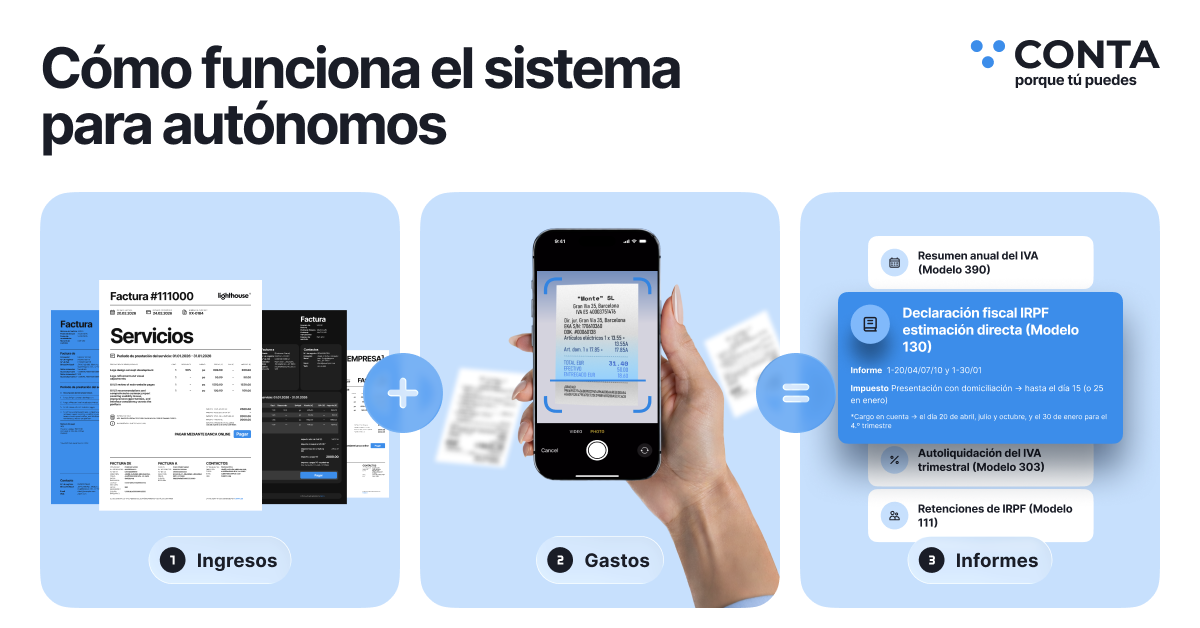
- Record income and expenses with predefined categories
- Scan receipts and invoices with OCR
- Connect your bank account to synchronise transactions
- Prepare data for forms 130, 303, 390, 111, 115, 349 and 180 (coming soon)
- View a tax calendar with filing deadlines
- Store all documentation permanently in the cloud
Multilingual for international professionals
The system is available in 4 languages: Spanish, Romanian, English and Russian. This is especially helpful for foreign self-employed workers and digital nomads who work in Spain and want to understand their taxes in their native language.
Real-time control
You can see your accumulated income, estimated deductible expenses and projected taxes at any time. This allows you to make informed decisions: for example, investing in equipment before year-end if your profit is high.
You can try Conta.es free of charge for two months. Upload your first expenses, see how they are organised by category and tax year, and decide if it works for you.
Even if you work with an external advisor, having all expenses digitised and categorised in Conta.es greatly facilitates communication. Your accountant will have access to organised information, reducing the time needed to prepare the Income Tax return and quarterly forms.
Conclusion: optimising taxes without risks and with control
Knowing which expenses are deductible, documenting them correctly and keeping them organised allows you to pay exactly what you owe, without taking unnecessary risks with the Tax Agency. It is not about “finding tricks” to pay less, but about reflecting the reality of your business with the right documentation.
Every profession - IT, design, marketing, construction, beauty, education, healthcare - has its own specifics in terms of which particular expenses are most relevant. But the general rules for deductibility are the same for everyone: link to the activity, proper documentation and correct accounting record.
I invite you to review your own expenses from the last quarter or year. You will probably find items you could be deducting but are not, or the opposite: expenses you are reporting without adequate documentation.
If you want to start recording and storing all your deductible expenses systematically, take advantage of the 60-day Conta.es trial. Ahead of your next quarterly settlement and the 2025 Income Tax campaign, having all your information organised will make a real difference.