
Verifactu: key aspects you should know as a freelancer in 2026


 22. January, 2026
The long-awaited mandatory implementation of Verifactu, the new system for issuing invoices with traceability and verification before the Spanish Tax Agency, will not become mandatory in 2026 as initially announced.
The Spanish Government has approved a one-year postponement, setting its entry into force for 2027.
This change is especially important for self-employed individuals and SMEs, who now have more time to adapt their invoicing systems and comply with the new tax requirements without rush or unexpected penalties.
Before going into the new dates, it is worth remembering that we already explained in detail what Verifactu is and why it is important for self-employed professionals and companies in an article we published in 2025.
In that guide, we analyzed how the system works, the objectives pursued by the Spanish Tax Agency, and why it forms part of the invoicing digitalization process in Spain.
🗓️ New Verifactu deadlines for self-employed individuals and companies
According to the updated regulations:
- January 1, 2027: mandatory for corporations and companies subject to Corporate Income Tax.
- July 1, 2027: mandatory for self-employed individuals and other SMEs using invoicing software.
These dates replace the deadlines previously scheduled for 2026, providing additional time for the orderly implementation of the system.
What is Verifactu and why does it matter?
Verifactu is an electronic invoice verification system promoted by the Spanish Tax Agency within the framework of the Anti-Fraud Law.
Its objective is to:
- Guarantee the integrity and traceability of issued invoices.
- Prevent manipulation or errors in invoicing.
- Facilitate secure and automatic access to information by the Tax Agency.
This means that the invoicing systems you use must be certified, capable of generating tamper-proof records, and comply with specific technical requirements.
Important: Verifactu is not simply “electronic invoicing”, but a digital verification and control mechanism for invoicing.
What does this postponement mean for you as a self-employed professional?
This change does not eliminate the obligation, but extends the deadlines so that you can:
- Review whether your current invoicing software is ready.
- Evaluate alternatives and providers that meet the technical requirements.
- Plan the transition without rush or unnecessary costs.
The delay provides relief for many professionals who had not yet adapted their systems or who had invested time and money expecting an earlier implementation.
Tips to prepare properly before 2027
Although the deadline has been extended, it is advisable to start as soon as possible:
1. Review your invoicing software
Make sure your program:
- Allows you to generate traceable and tamper-proof records.
- Can comply with the technical requirements required by Verifactu.
2. Consult your accountant or advisor
Your advisor will be able to guide you on:
- What changes are necessary according to your activity.
- How to plan the transition to avoid penalties.
3. Plan calmly
The postponement does not mean you can leave it until the last moment.
The ideal approach is to adapt your processes step by step before 2027.
In summary
✔️ The mandatory implementation of Verifactu has been postponed to 2027.
✔️ Companies start in January and self-employed professionals in July of that year.
✔️ The objective remains to combat fraud and modernize invoicing.
✔️ You have more time to adapt your tools and procedures.
Better not to wait until the last minute
Although the mandatory implementation of Verifactu has been postponed until 2027, it is highly recommended not to leave the adaptation until the end.
Experience with other regulatory changes shows that many self-employed professionals end up implementing these systems in a rush, without time to test them properly or understand how they work.
Adopting Verifactu in advance will allow you to adapt progressively, calmly review your invoicing processes, and avoid mistakes that, once it becomes mandatory, could result in penalties from the Spanish Tax Agency.
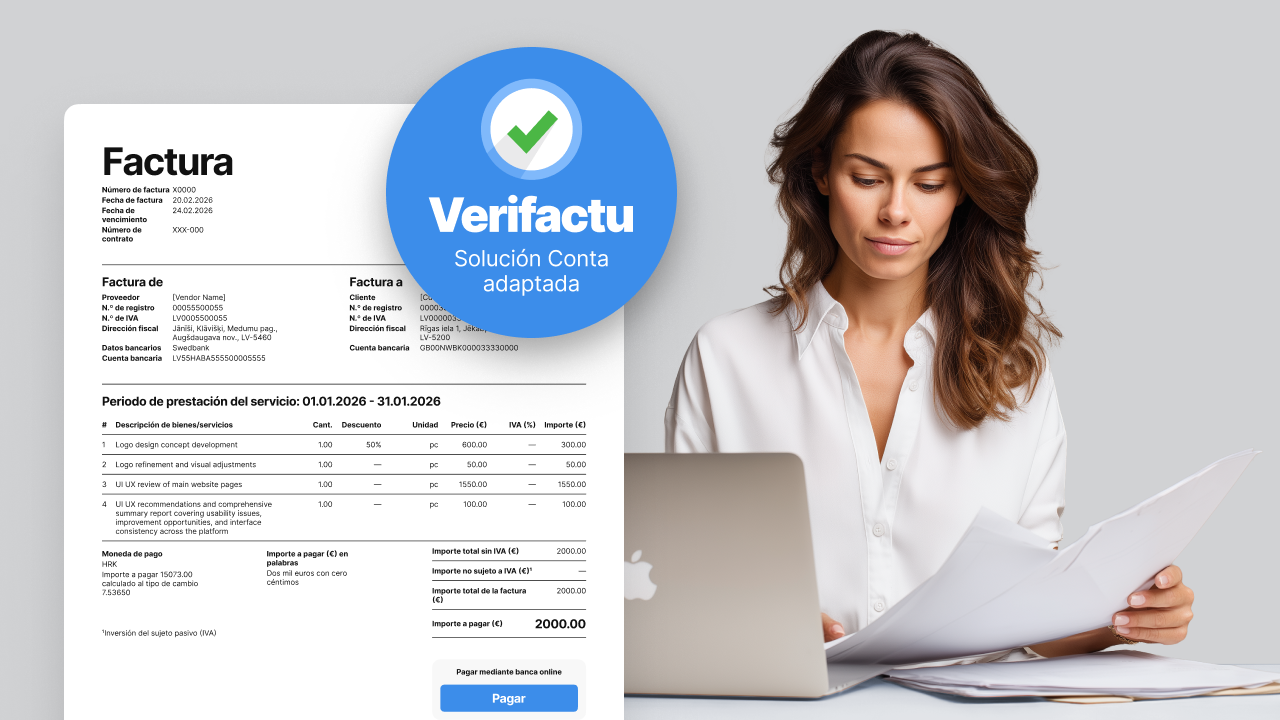
At Conta.es we have already taken this step: our system is compatible with Verifactu and self-employed professionals can issue electronic invoices from today at no additional cost.
This way, you can start familiarizing yourself with electronic invoicing, test the system in your daily activity, and reach 2027 with everything under control, without rush or surprises.
The postponement is an opportunity to prepare better, not to delay it indefinitely.
Get ahead of the change
Although the mandatory implementation of Verifactu has been postponed, the change is inevitable.
The difference will lie in how you reach 2027: with rush, doubts and risks… or with processes already internalized and running normally.
Taking advantage of this margin allows you to familiarize yourself with electronic invoicing without pressure, understand how Verifactu works in your day-to-day operations, and adjust your processes calmly.
It is the best way to avoid last-minute mistakes and possible penalties when the system becomes mandatory.
At Conta.es we are already prepared: our solution is compatible with Verifactu and allows you to issue electronic invoices from today, free of charge.
This way you can start using the real system you will need in the future, without abrupt changes or stress.
Getting ahead is not an obligation, but it is an advantage.
If you are self-employed and want to reach 2027 with everything under control, you can start using Conta.es now and adapt to the new invoicing model with peace of mind and confidence.