
Deductible expenses for the self-employed (autónomo) working from home: utilities, IRPF


 29. October, 2026
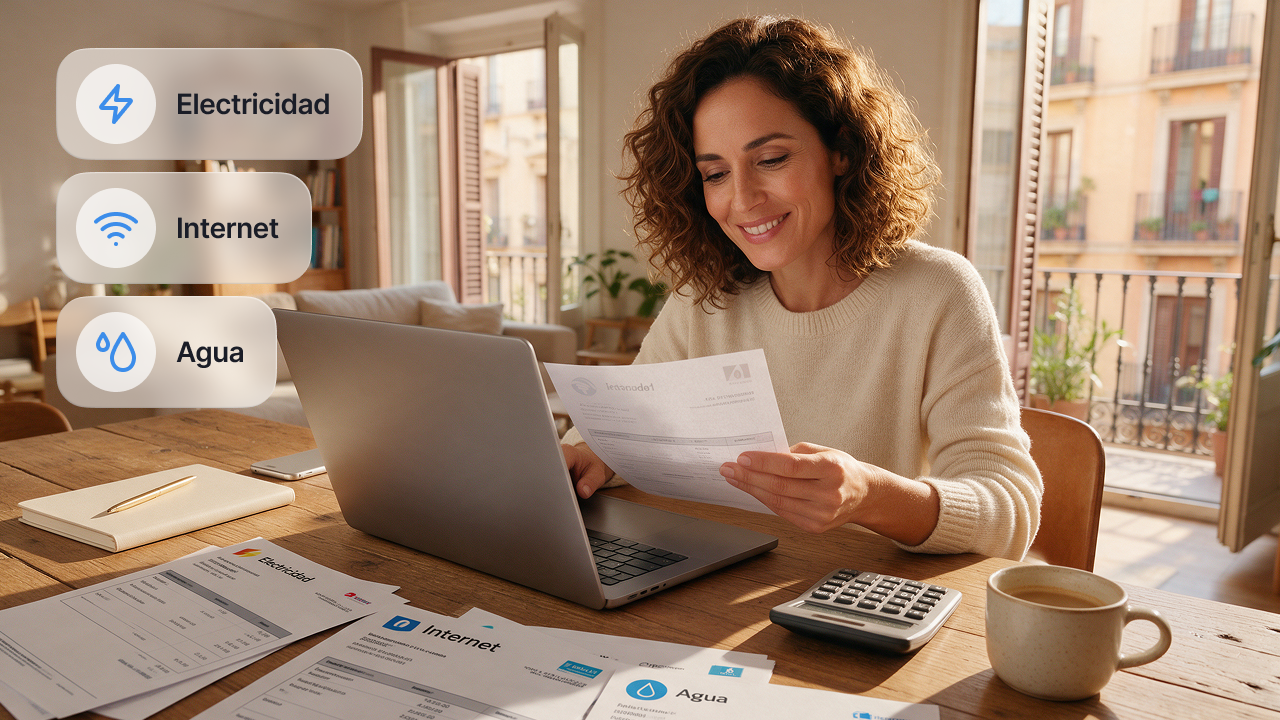
The deductible expenses of the self-employed working from home fall into two groups. Utilities (electricity, water, gas, telephone and internet) are deducted in personal income tax (IRPF) by applying 30% to the share of the home allocated to the business. Expenses of the property itself (rent, IBI property tax, homeowners' association fees, insurance, mortgage interest or depreciation) are deducted in proportion to the square metres used for the business. In addition, since 2023 the VAT on utilities can also be deducted in proportion to its business use. To back all of this up, the allocation of the home to the business must be reported to the Tax Agency (Hacienda) on modelo 036.
Legal framework: Law 6/2017 and article 30.2.5ª of the IRPF Law
Law 6/2017 of 24 October on Urgent Reforms of Self-Employment (Ley 6/2017, de Reformas Urgentes del Trabajo Autónomo) set a clear rule for home expenses. It amended article 30.2.5ª of the IRPF Law and established, with effect from 1 January 2018, how the utilities of the main home are attributed to the business. The rule is still in force, unchanged.
Before this reform, every tax return was exposed to inconsistent criteria from the tax authorities. Today, the self-employed have a solid legal basis to apply the utilities deduction for the self-employed in their main home.
What requirements does the Tax Agency set for this deduction?
The law requires the allocation of the home to be real and partial: a specific part of the property, which can be separated from the rest, must be used for the business. A corner of the living room is not enough; a room used as an office is.
The way to record this with the AEAT (Spanish Tax Agency) is modelo 036, the census registration form (declaración censal). The simplified modelo 037 no longer exists: it was abolished with effect from 3 February 2025, and since then all registrations and changes are filed on modelo 036. Although the law does not expressly make it a condition for deducting, the census registration is the main evidence of the allocation, and without it the Tax Agency is very likely to reject the expenses in a tax review.
The rule only applies to those taxed under direct assessment (estimación directa), standard or simplified. Under objective assessment (módulos), the net income is calculated with fixed parameters and actual expenses are not deducted.
Which utility expenses does the law cover?
Article 30.2.5ª mentions water, gas, electricity, telephone and internet, but only as examples ("such as"), so the list is not closed. The self-employed can deduct internet and electricity, as well as the rest of the home's utilities, within the limit set by the law. The complete guide to deductible expenses details the documentation requirements for each category.
The home deduction percentage the Tax Agency accepts for the self-employed is obtained by applying 30% to the proportion of square metres used for the business over the total floor area of the home, unless a higher or lower percentage can be proven.
Prerequisite: allocating the home on modelo 036
Reporting the allocation on the census registration is the step that backs up all home expenses. It is not enough for the home to be listed as your tax address. It must also be listed as the place where the business is carried out, together with the square metres used for it.
The allocation is reported on modelo 036 for home allocation, both when registering as self-employed for the first time and when updating an existing situation.
What do you fill in on modelo 036 for partial allocation?
In the section of the census registration about the place where the business is carried out, you state that you work from your home. You then enter the total square metres of the property and those used for the business. That figure sets the allocation percentage that will later apply to the home expenses and, with the 30% cap, to each utility bill.
The process follows these steps:
-
Open modelo 036 in the AEAT online office (Sede Electrónica).
-
Find the section on the place where the business is carried out and state that it is your main home.
-
Enter the total square metres of the home and, separately, those used for your professional activity.
-
Review the rest of your census data, including your activity codes and the taxes you pay, to confirm they reflect your actual situation.
Can you change the allocation if the square metres change?
Yes. The change is filed on a new modelo 036 updating the square metres used for the business. Keep the filing receipt. The new percentage applies from the date of the filing, not to earlier periods.
The square metre figure is not a mere formality. The deductible part of every expense is calculated on it, and a mistake in the reported figure leads to an incorrect deduction.
The 30% formula: how to calculate the utilities deduction
Calculating the utilities deduction correctly means you don't lose money the Tax Agency allows you to recover. Home expenses fall into two groups with different rules, and mixing them up is the most common mistake.
Which utilities are included in the 30% calculation?
The law gives these utilities as examples:
-
Electricity
-
Water
-
Gas
-
Telephone and internet
Property expenses, such as homeowners' association fees, IBI or rent, follow a different rule and are not part of this group.
How is the deduction percentage applied?
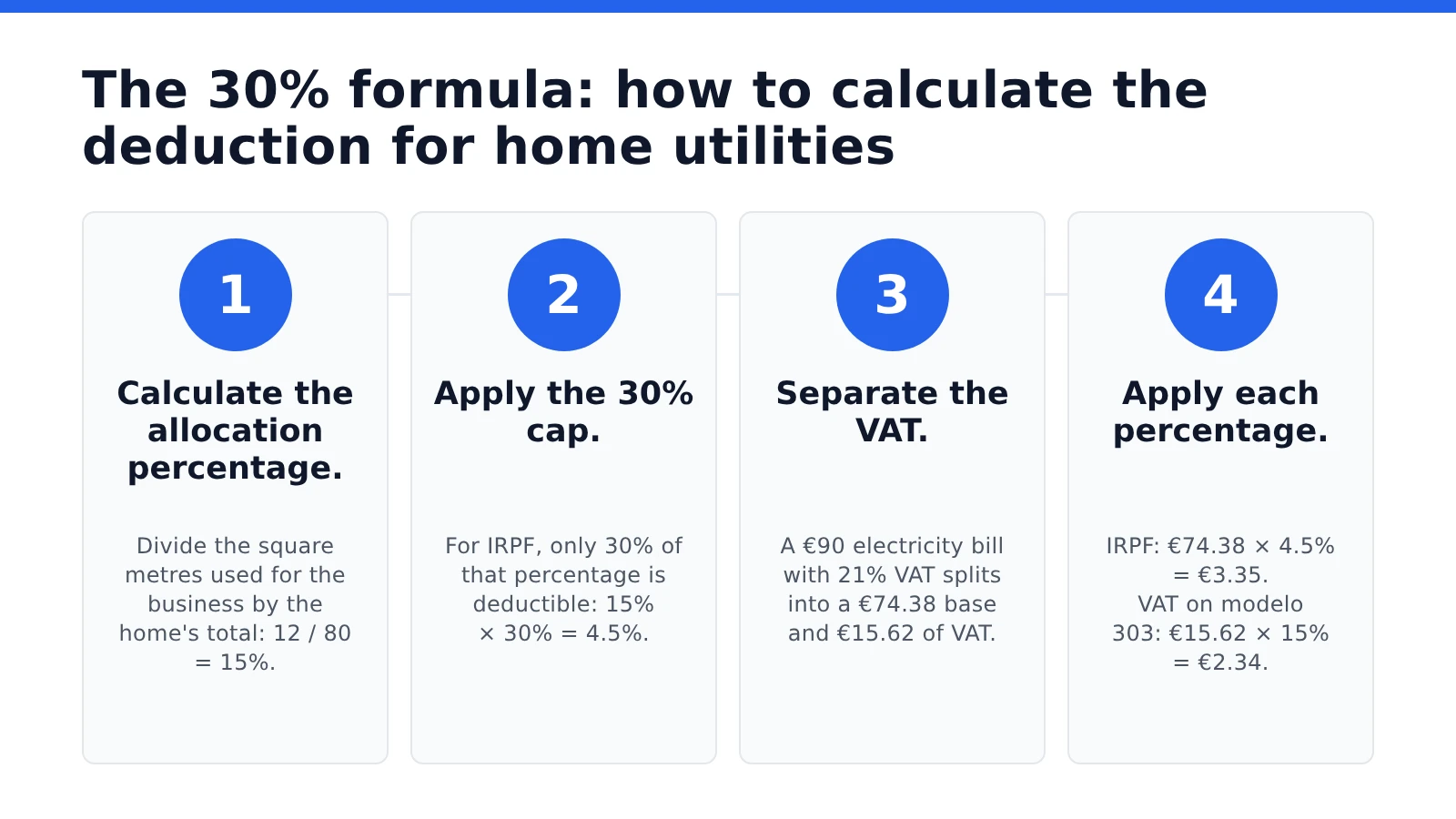
The calculation has two filters applied in order. Take as an example an 80 m² home with 12 m² used for the business and a €90 electricity bill, VAT included:
-
Calculate the allocation percentage. Divide the business square metres by the total: 12 / 80 = 15%.
-
Apply the 30% cap. For IRPF, only 30% of that percentage is deducted: 15% × 30% = 4.5%.
-
Separate the VAT on the bill. At 21% VAT, the €90 splits into a €74.38 taxable base and €15.62 of VAT.
-
Apply the rate to the taxable base. The expense deductible in IRPF is 4.5% of the base: €74.38 × 4.5% = €3.35.
-
Deduct the proportional VAT. VAT is deducted in proportion to business use. Applying the allocation percentage: €15.62 × 15% = €2.34 of VAT deductible on modelo 303.
If your business is VAT-exempt (for example, certain healthcare or educational services) or taxed under the RE regime (recargo de equivalencia), the VAT cannot be deducted. In that case, the VAT becomes part of the expense and the 4.5% applies to the full bill: €90 × 4.5% = €4.05.
Do the bills have to be in the self-employed person's name?
It is recommended and, to deduct VAT, essential, because the deduction requires an invoice. For IRPF the law does not expressly require it: what matters is being able to prove the expense is real and paid by you, for example with charges to your account. If the home belongs to both spouses under community property (gananciales), the Tax Agency counts all the square metres allocated to the business. Even so, having the contracts in your name, or in both names, avoids disputes in a tax review.
Worked example with real figures, step by step
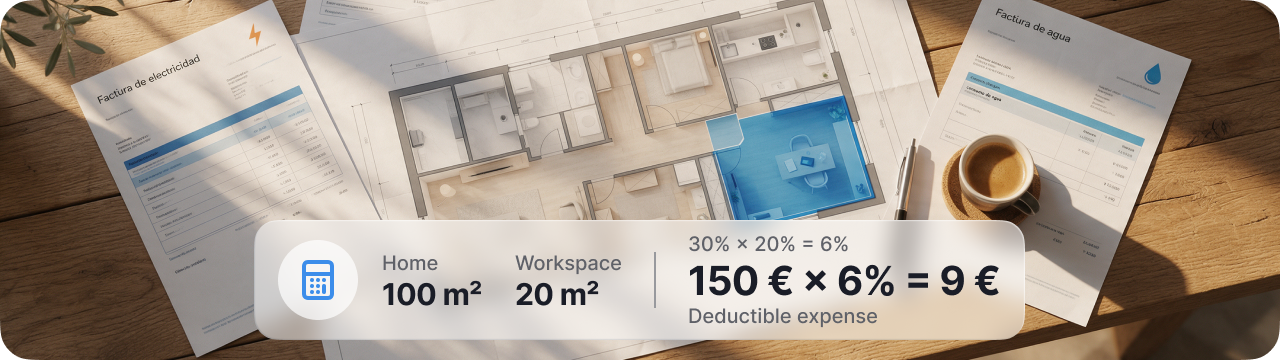
This example applies the rule to a complete case. Take a 100 m² home with a 20 m² office, a €200 electricity bill including 21% VAT and rent of €900 a month.
How is the deductible percentage obtained?
-
Calculate the allocated share. 20 m² / 100 m² = 20%.
-
Apply the 30% cap to utilities. 20% × 30% = 6%.
How much is deducted from a €200 bill?
-
Separate base and VAT. €200 = €165.29 taxable base + €34.71 VAT.
-
Expense deductible in IRPF. €165.29 × 6% = €9.92.
-
VAT deductible on modelo 303. €34.71 × 20% = €6.94.
If the business is VAT-exempt, the calculation is made on the full bill: €200 × 6% = €12 of IRPF expense, with no deductible VAT.
| Item | Business with VAT | VAT-exempt business |
|---|---|---|
| Total area / office | 100 m² / 20 m² | 100 m² / 20 m² |
| Allocation percentage | 20% | 20% |
| Deductible percentage of utilities in IRPF | 6% | 6% |
| Amount the calculation is based on | €165.29 (base before VAT) | €200 (VAT included) |
| Expense deductible in IRPF | €9.92 | €12 |
| Deductible VAT (modelo 303) | €6.94 | €0 |
| €900/month rent deductible in IRPF | €180/month | €180/month |
Rent is deducted at 20%, without the 30% cap, because it is a property expense and not a utility. Residential rent is VAT-exempt, so there is no VAT to deduct. The rental contract should be in your name.
VAT on water is usually 10%, not 21%, so on that bill you need to separate base and VAT at the correct rate. The calculation is repeated for each bill, and you should keep all supporting documents.
Utilities vs property expenses: differences in IRPF and VAT
The distinction between utilities and property expenses determines how much a self-employed person working from home can deduct. The treatment also changes depending on the tax.
Which property expenses are deductible in IRPF?
Expenses linked to owning or using the property include IBI, homeowners' association fees, home insurance, mortgage interest (not capital repayments), depreciation of an owned home (on the value of the building, excluding the land) and rent. They are deducted by applying the percentage of allocated square metres directly, without the 30% cap. If the home is jointly owned, your ownership share is also applied.
How does the 30% rule apply to utilities?
Utilities follow a stricter rule: in IRPF only 30% of the share of the home allocated to the business is deducted, unless a higher or lower percentage can be proven.
What happens with VAT on home expenses?
VAT on utilities is deductible in proportion to their business use. Several property expenses, on the other hand, carry no VAT: IBI is a tax, homeowners' association fees are not usually invoiced with VAT and residential rent is exempt.
| Item | IRPF | VAT |
|---|---|---|
| IBI and homeowners' association fees | Deductible according to allocated square metres | Not applicable: no VAT charged |
| Utilities (electricity, water, gas, internet) | Deductible with the 30% cap on the base before VAT | Deductible in proportion to business use |
| Rent of the home | Deductible according to allocated square metres | Not applicable: residential rent is exempt |
| Interest and depreciation (owned home) | Deductible according to allocated square metres and ownership share | Not applicable |
VAT on utilities: the 2023 change of criterion
For years, the Tax Agency held that VAT on the utilities of a partly allocated home was not deductible, because they were not used exclusively for the business. That position has changed.
What do the TEAC, the Tax Agency and the Supreme Court say now?
-
TEAC, July 2023. The Central Economic-Administrative Court (TEAC) ruled, in a resolution unifying doctrine, that VAT on the utilities of a property used both for business and private purposes is deductible in proportion to its business use.
-
Directorate General of Taxes (DGT), 2023 and 2025. The Tax Agency adopted that position in its binding rulings and has repeated it since.
-
Supreme Court, July 2025. Judgment 976/2025 confirmed the right to deduct VAT on utilities in proportion to the business use of the home.
How is deductible VAT calculated?
The law does not set a specific formula: it refers to the proportion of business use. The most common approach is to apply the home's allocation percentage (the square metres) to the VAT amount, without the 30% factor, which is a rule specific to IRPF. As this is an interpretation, you should be able to prove the actual use of the space if the Tax Agency questions it.
To deduct VAT you need an invoice, and the safe option is for it to be in your name. If you already deduct the VAT on modelo 303, remember that in IRPF the expense is calculated on the base before VAT. Counting the VAT in both taxes would be a double deduction. Read more about other deductible expenses for the self-employed in Spain.
Good practices to avoid AEAT notices and penalties
The Tax Agency looks closely at the deductions claimed by people who work from home. Prevention rests on three pillars: thorough documentation, a correct percentage and formal reporting of the allocated space.
What documents should you keep?
Invoices and receipts must be kept for at least the limitation period, which is four years. They should include your tax ID (NIF), the date and the description, and you should also keep proof of payment. If you take out a phone or internet line used exclusively for work, it can be deducted in full, provided you can prove that exclusive use.
Can the Tax Agency reduce the percentage based on working hours?
In some tax reviews, the Tax Agency has applied a second reduction based on daily working hours. The High Court of Justice of Madrid (TSJ), in a judgment of September 2025, rejected that cut because the law does not provide for reducing the percentage based on time of use. It is the position of a regional court, not the Supreme Court, but it strengthens the position of self-employed people who apply the legal formula.
How do you apply the percentage without raising red flags?
The key is to stick to the actual area used for work and reported on modelo 036. An inflated percentage with no evidence turns a legitimate deduction into a penalty risk. Also bear in mind that allocating part of your main home can have tax consequences if you sell it, because the tax benefits for a main home do not extend to the allocated part.
In short: allocation reported, separable space, realistic percentage, invoices in your name whenever possible and proof of payment kept.
Manage your deductible expenses with Conta
Conta is invoicing and accounting software for the self-employed that makes it simple to record your day-to-day expenses, including those of the home you work from.
Keeping your books without the right tool takes hours every week and increases the risk of mistakes in your tax returns. Conta covers everything from issuing VeriFactu-compliant invoices to preparing your taxes.
How does Conta help with home expenses?
Conta lets you record your electricity, internet or water bills and assign each expense to its category. Based on your income and expenses, it calculates VAT and IRPF and automatically prepares modelos 303 and 130, as well as the annual summaries, with their reports. You review them and file them in the AEAT online office (Sede Electrónica).
What if you work with an accountant (gestor)?
You can give your accountant access to review and supervise your tax returns inside the software. If you also want a complete view of your finances, read the guide on how to manage personal and business expenses in one place.
Conclusion
The deductible expenses of the self-employed working from home rest on three steps: reporting the allocation of the home on modelo 036, applying the right percentage to each expense and keeping invoices and proof of payment. In IRPF, utilities are deducted with the 30% cap on the allocated part, and property expenses in proportion to the square metres. For VAT, since 2023 utilities are deductible in proportion to business use, a position the Supreme Court confirmed in 2025. With an orderly record of every expense, your deduction is well supported in any tax review by the AEAT.