
VeriFactu Software for the Self-Employed: Complete Guide


 28. September, 2026
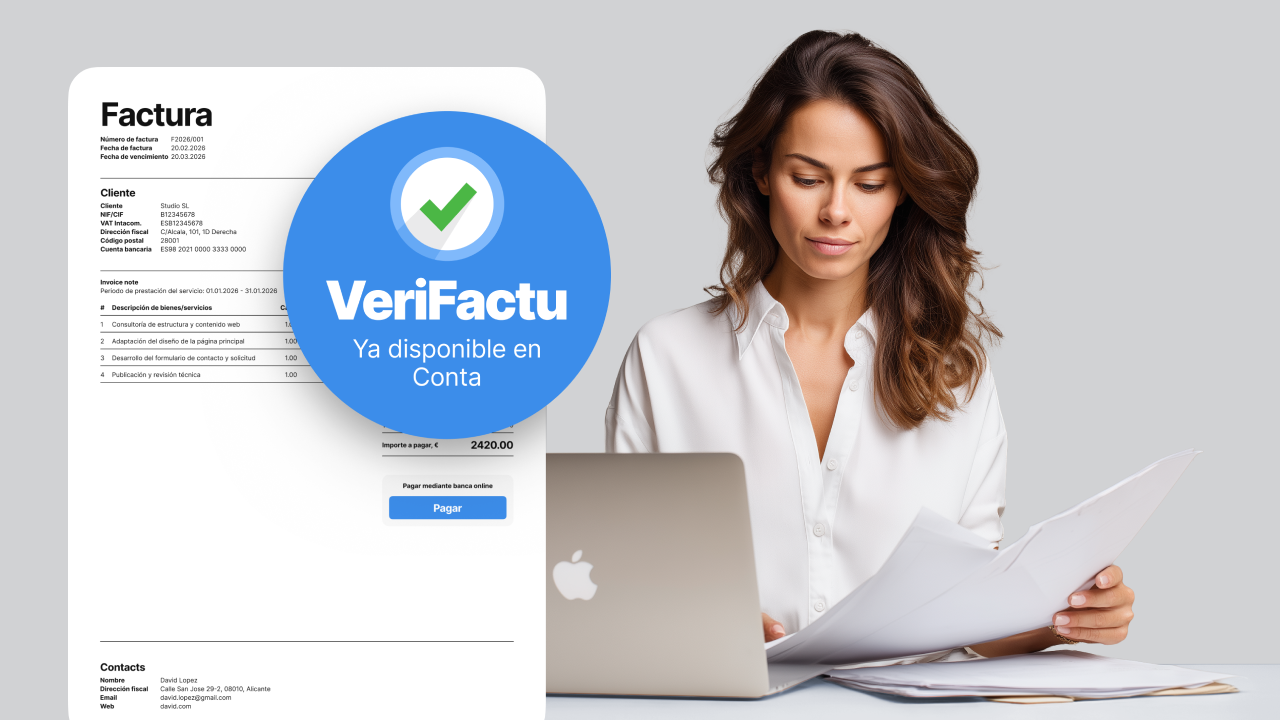
VeriFactu is the system created by the Spanish Tax Agency (AEAT) to ensure invoices generated by software are secure, traceable, and cannot be altered or deleted. For the self-employed, it will become mandatory from 1st July 2027. Conta.es is already fully VeriFactu compliant, offering automated invoicing and a 180-day free trial with no card required.
VeriFactu is the verifiable electronic invoicing system required under Royal Decree 1007/2023 and the Anti-Fraud Law, mandatory for the self-employed according to the Tax Agency's official timetable. Conta.es meets these requirements: it automates invoice issuance, recognises receipts with time savings of up to 80%, and lets you collect payments without a card terminal via QR code or payment link.
What Is VeriFactu and Why Does It Affect You?
VeriFactu is the Spanish Tax Agency's invoicing control system that requires the self-employed to use certified VeriFactu software to issue invoices. This system transforms the way the Tax Agency oversees the economic activity of independent professionals in Spain. Without software that meets the Hacienda VeriFactu regulations, any self-employed professional is exposed to penalties and stricter tax scrutiny.
The VeriFactu regulation sets out the requirements that invoicing software in Spain must meet in order to prevent tax fraud. In practice, this means that VeriFactu software for the self-employed must be able to submit all invoicing records to the Tax Agency electronically. It isn't about sending every invoice in real time, but about the system guaranteeing the integrity and traceability of the data.
What Really Changes for a Self-Employed Professional?
The fundamental change lies in the software used for invoicing. VeriFactu invoicing software must be able to generate an invoicing record that the Tax Agency can verify. This removes the possibility of tampering with invoices after they've been issued.
|
Aspect |
Before VeriFactu |
With VeriFactu |
|---|---|---|
|
Software |
Any program would do |
Only certified VeriFactu software |
|
Учёт |
No external control |
Verifiable electronic record |
|
Risk |
Low oversight |
Greater tax transparency |
Why Should the VeriFactu 2027 Deadline for the Self-Employed Concern You?
The VeriFactu 2027 deadline for the self-employed is the final date to adapt. Those who fail to meet the Hacienda VeriFactu regulations before that date face financial penalties and greater scrutiny from the Tax Agency. The VeriFactu invoice with QR code will become a standard for guaranteeing the authenticity of every document. AEAT-compliant invoicing software for the self-employed that meets these requirements isn't optional, it's a legal obligation.

What Is the VeriFactu 2027 Deadline for the Self-Employed?
The VeriFactu 2027 deadline for the self-employed is set for 1st July 2027. The Spanish Government confirmed this postponement on 2nd December 2025, through the official publication of Royal Decree-Law 15/2025 in the BOE on 3rd December 2025. The Hacienda VeriFactu regulations establish that every self-employed professional using certified VeriFactu software to issue invoices must comply with the system from that date.
Without adapting to the new system, the self-employed are exposed to greater control and oversight from the Tax Agency. Missing the chance to prepare in advance means taking on the risk of invoicing errors and possible penalties. Those who start using VeriFactu invoicing software ahead of the mandatory deadline gain peace of mind and day-to-day efficiency.
What Dates Apply to Businesses and the Self-Employed?
The new entry-into-force dates, following the December 2025 postponement, are as follows:
| Group | Mandatory date |
|---|---|
| SMEs and large companies | 1st January 2027 |
| Self-employed and remaining businesses | 1st July 2027 |
This six-month gap gives self-employed professionals extra time to choose and implement AEAT-compliant invoicing software for the self-employed that meets the regulation's technical requirements.
What Does the July 2027 Deadline Mean for a Self-Employed Professional?
From 1st July 2027, any VeriFactu software for the self-employed used to generate invoices must be certified by the Tax Agency. The system doesn't require sending every invoice to the Tax Agency in real time, but it does require the software to guarantee the integrity, traceability and tamper-evidence of invoicing records. A VeriFactu invoice with QR code is one of the technical measures the software must incorporate to comply with the regulation.

What Do the Hacienda VeriFactu Regulations Require?
The Hacienda VeriFactu regulations do not require sending invoices to the Tax Agency in real time. The fundamental change affects the software the self-employed use to issue those invoices. Royal Decree 1007/2023 and the Anti-Fraud Law have transformed invoicing control in Spain, and the deadline to adapt is already set.
The mandatory date for the self-employed in Spain is 1st July 2027, under Royal Decree-Law 15/2025, of 2nd December, published in the BOE on 3rd December 2025. Those taxed under the modules system or direct estimation must meet the same timetable. Missing this deadline exposes the self-employed professional to greater tax scrutiny and penalties no small business can afford.
What Must Invoicing Software Comply With?
Certified VeriFactu software must guarantee the integrity, preservation and traceability of invoicing records. The software cannot allow invoices that have already been issued to be altered. Every invoice must generate a registration record linked to the previous one with a hash code, creating a tamper-evident chained record. VeriFactu invoicing software must also generate a unique QR code for each invoice.
What Changes in the Self-Employed Professional's Day-to-Day?
The self-employed professional must use AEAT-compliant invoicing software for the self-employed that meets these requirements. The VeriFactu invoice with QR code replaces traditional systems. The software must be able to export records in the standardised format the Tax Agency requires. Failing to comply with the Hacienda VeriFactu regulations means operating outside the law from July 2027 onward.
| Key requirement | What the regulation requires |
|---|---|
| Software | Must be certified and approved |
| Records | Tamper-evident chained record with hash |
| Invoices | Unique QR code per invoice |
| Deadline | 1st July 2027 for the self-employed |
Collecting Payments with a VeriFactu Invoice and QR Code
Issuing a VeriFactu invoice with QR code simplifies payment collection for any professional without a cash register. The system lets you receive payments instantly through a QR code or a direct link, a solution built for those who offer services on the go. The whole flow is surprisingly smooth: you create the quote, the customer scans it with their phone, and the payment goes through in seconds.
What are the advantages of QR code payments compared to traditional payment methods?
The main advantage is immediacy. A self-employed professional who finishes a repair job or a consultation can collect payment before saying goodbye to the client, without relying on a later bank transfer or a complex payment process. The client only needs their phone, and the payment is automatically logged in the invoicing system. This does away with the classic problem of unpaid invoices piling up at the end of the month.
How does QR integrate with the VeriFactu regulations?
Integration with the Hacienda VeriFactu regulations comes naturally when you use certified VeriFactu software. QR payment collection isn't a standalone extra, it's just another piece of the automated invoicing flow. Conta.es stands out for its VAT-compliant system, where every payment received feeds directly into the tax records. The professional doesn't need to reconcile anything afterwards: payment and invoice travel together.
The practical flow comes down to three steps:
-
1. Create and send the invoice or quote.
-
2. The customer scans the QR code with their phone.
-
3. The payment is received and logged automatically in the system.
For a self-employed professional without administrative back-up, this method cuts the friction out of getting paid and keeps the traceability the Tax Agency requires. Those who delay adapting to these systems risk losing payments to client inconvenience or carrying forward record-keeping errors. VeriFactu invoicing software with integrated payment turns regulatory compliance into a daily operational advantage, not a bureaucratic burden.
Centralised Accounting Management for the Self-Employed
AEAT-compliant invoicing software for the self-employed centralises all accounting management in a single platform. The system simplifies the entire process, from issuing invoices to calculating taxes, without requiring any prior accounting experience. This automation eliminates the manual errors that trigger Tax Agency reviews.
VeriFactu software for the self-employed includes automatic recognition of receipts and invoices. This feature digitises documents with a simple photo or scan. The automation saves up to 80% of the time compared with manual data entry. That difference translates into hours reclaimed every week to put back into the business.
What are the advantages of bank integration?
Bank integration logs business transactions quickly, accurately and transparently. Every movement in the account syncs automatically with the system. This saves the self-employed professional the tedious work of recording every income and expense one by one.
Which reports does the system generate automatically?
VeriFactu invoicing software generates every report and tax return automatically. The tax calendar covers everything from quarterly filings to the annual summary. The self-employed professional simply enters their income and expenses, the system calculates the taxes for them. The system's main features include:
-
Automatic recognition and digitisation of receipts and invoices
-
Bank integration that syncs every transaction automatically
-
Automatic generation of quarterly tax reports and the annual summary
Certified VeriFactu software guarantees that every invoice meets the legal requirements. A self-employed professional who automates these processes reduces the risk of penalties. The peace of mind of knowing your invoicing is up to date is priceless.
How to Choose the Best VeriFactu Software for the Self-Employed
The best VeriFactu software for the self-employed complies with the Hacienda VeriFactu regulations and simplifies accounting management without relying on an external accountant. The VeriFactu 2027 deadline for the self-employed requires the use of certified VeriFactu software to issue invoices from 1st July 2027. A platform that automates processes and offers features such as invoice issuance, payment tracking and tax report generation saves up to 80% of the time compared with manual data entry, according to industry figures. The key is finding VeriFactu invoicing software that fits the volume of operations and the level of automation each business needs.
Choosing AEAT-compliant invoicing software for the self-employed means looking at three fundamental aspects. First, certification with the Tax Agency: the software must guarantee the integrity, traceability and tamper-evidence of the invoicing records required by Royal Decree 1007/2023. Second, automation features: systems that let you issue a VeriFactu invoice with QR code and receive payments instantly via QR code or link, ideal for services with no cash register, speed up the collection cycle. Third, language support: a platform with assistance in several languages, Spanish, English, Russian and Romanian, makes things easier for self-employed professionals with international clients.
Which features should I prioritise?
The most relevant features include automatic recognition of receipts and invoices, which eliminates manual data entry. A built-in tax calendar that automatically generates quarterly reports and the annual summary reduces the risk of errors and penalties. Receiving payments without a physical terminal, via QR code, is especially practical for professionals who invoice from mobile locations.
Which subscription model is right for me?
The platform offers a subscription model with basic, pro or premium plans, depending on the level of service and automation required. A self-employed professional who issues fewer than 50 invoices a month can cover their needs with the basic plan, while businesses with a higher volume of operations benefit from the advanced features of the pro or premium plan. The 180-day free trial lets you explore every premium feature with no credit card required, an advantage for assessing the fit before making a financial commitment.
Why Prepare Early for the VeriFactu 2027 Deadline
Early preparation makes the difference between a smooth transition and an administrative headache. Self-employed professionals who get organised in good time will avoid invoicing errors and gain peace of mind with the Tax Agency. Those who wait until the last minute risk penalties and disorganised financial management that eats up hours of work.
What are the benefits of starting now?
Preparing in advance lets you manage invoicing more efficiently and accurately. VeriFactu software for the self-employed set up properly from the start removes the need to correct invoices issued with uncertified systems. Knowing that every document meets the Hacienda VeriFactu regulations avoids nasty surprises in future inspections.
How do I choose the right programme?
Choosing the right VeriFactu invoicing software determines how smooth the daily process is. Certified VeriFactu software must meet the technical requirements of Royal Decree 1007/2023 and offer practical features such as automatic recognition of receipts, a built-in tax calendar and QR code payment collection.
With the VeriFactu 2027 deadline for the self-employed set for 1st July, every month of preparation counts. A self-employed professional who sets up their system in 2026 has months to test the software, fix errors and establish routines without pressure. Those who wait until June 2027 face technical support queues, last-minute rushing, and the risk of issuing non-compliant invoices from day one.
In short, VeriFactu stands as an unavoidable requirement for Spanish self-employed professionals who want to comply with current tax regulations. Its implementation guarantees the traceability of transactions and simplifies the invoicing process, freeing independent workers to focus their efforts on growing their business instead of losing time on complex administrative procedures. Adopting a system that integrates this functionality is essential for staying tax-compliant and avoiding unnecessary penalties.