
Free webinar: self-employed in Spain - registration, taxes and accounting step by step


 7. May, 2026
Content:
- When is it necessary to register as self-employed?
- Where and how can you register?
- Choosing and comparing forms of economic activity.
- The most suitable tax regime with examples.
- Mandatory tax returns.
- A complete example.
- Managing your own accounting.
- Questions and answers.
In this webinar, we will explain how chronological recording of transactions and the correct application of accounting standards, whether approved by law or regulated by professional organizations, are essential. In addition, we will cover the legal and accounting obligations of self-employed people in Spain.
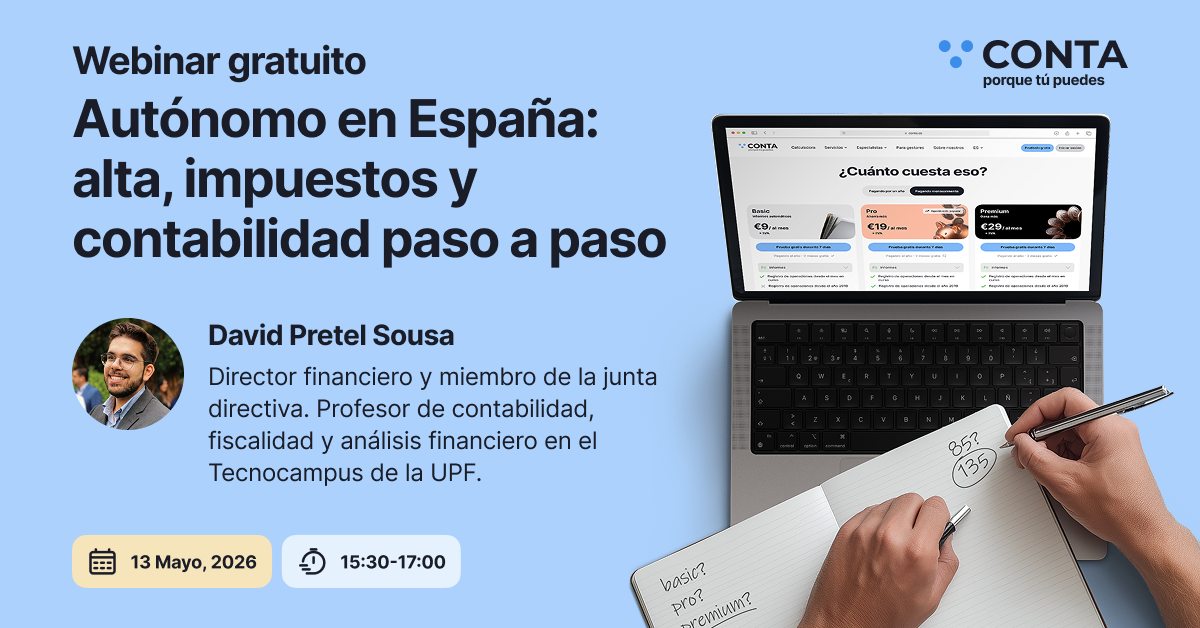
When: 13 May, 15:30-17:00
The webinar will be held in Spanish.
After the webinar, we will translate it into English, Romanian, Russian and upload the video to our YouTube channel.
Presenter:
David Pretel Sousa, Financial Director and member of the Board of Directors. Lecturer in accounting, taxation and financial analysis at Tecnocampus at UPF.
Webinar organizer: Conta.es, online accounting for self-employed people.
Send us your questions at [email protected], and we will answer some of them during the webinar.
Introduction to accounting for self-employed people
Accounting is an important tool for any self-employed person who wants to manage their business efficiently and professionally. Proper accounting makes it possible to record all economic transactions, from income to expenses, thereby making it easier to make informed decisions and meet tax obligations. This discipline helps not only to understand the real state of the business, but also to identify possible problems in advance, optimize resources and ensure profitability. Accounting involves the systematic recording of all transactions, which provides a clear and up-to-date view of business development.
Types of accounting applicable to self-employed people
Depending on the type of activity and the size of the business, self-employed people may use different types of accounting. Financial accounting is the most common and focuses on preparing reports that show the economic and financial situation, allowing equity and results obtained to be analyzed. On the other hand, cost accounting helps calculate the real cost of products or services, making it easier to set prices and control expenses. Finally, management accounting is focused on making strategic decisions by providing important information for planning the future of the business and improving efficiency. Knowing and applying these types of accounting allows self-employed people to have an overall view of their business and make the right decisions at the right time.
Basic accounting system for self-employed people
A basic accounting system for self-employed people should be designed to make it easier to record and control all economic transactions of the business. Such a system makes it possible to keep careful control of income and expenses, as well as tax obligations. In addition, the periodic preparation of financial reports helps analyze business development and comply with legal requirements. Using accounting software developed specifically for self-employed people can simplify these processes, automate tasks and reduce the risk of errors. In this way, accounting becomes an effective tool for business management and success.
Accounting records: what, how and when
Accounting records are the foundation of accounting for any company or self-employed person. These are documents that collect all important information about financial transactions: income, expenses, taxes and any other economic obligations. For these records to be useful, they must include the date, description and amount of each transaction, and they must be updated regularly to reflect the real financial position of the business. Keeping records electronically with the help of accounting software makes them easier to review and ensures accuracy. Maintaining organized and complete records is not only a legal obligation, but also makes it possible to make informed decisions and identify potential financial problems in advance.
Registering as self-employed in Spain: basic steps
Registering as self-employed in Spain involves completing a series of basic steps in order to comply with current legislation. The first step is to register the economic activity in the Commercial Register, which gives the business legal validity. Next, it is necessary to obtain a tax identification number (NIF) and register with the social security system in order to pay contributions and receive the corresponding benefits. In addition, self-employed people must comply with all tax and accounting obligations, such as filing tax returns and keeping the accounting books required by law. Professional advice during this process is highly recommended, as it helps avoid mistakes and ensures that all obligations are properly fulfilled from the very beginning of the activity.
During our webinar, we will answer some of the most frequent questions from self-employed people and those who are thinking about starting their own activity. This is an opportunity to clarify key concepts and learn in practice which obligations need to be taken into account from the very beginning.
We will be happy to see you at our free webinar on 13 May at 15:30.
We will talk about practical topics for self-employed people in Spain: registration, taxes, accounting and the daily management of income and expenses. You can send us your questions in advance at [email protected] and we will take them into account during the webinar.
Conta.es is a platform for accounting automation for self-employed people in Spain. It helps you control income and expenses, prepare reports and manage accounting in a simpler, clearer and more organized way.