
What taxes does a self-employed person pay in Spain


 8. March, 2026

- Every self-employed worker (autónomo) in Spain is mainly taxed through Personal Income Tax (IRPF) and VAT (IVA), in addition to paying a monthly Social Security contribution which, although not a tax, is still mandatory in Spain.
- Taxes in Spain are generally settled on a quarterly basis (in April, July, October and January) with some exceptions, and later regularised through annual returns such as the personal income tax return.
- The actual tax burden in Spain depends on net income (income minus deductible expenses) and the chosen regime: direct estimation, modules or applying withholding on invoices.
- This guide is useful both for those considering registering as self-employed in Spain and for those already active, and the system is compatible with managing your taxes on your own or together with an advisor.
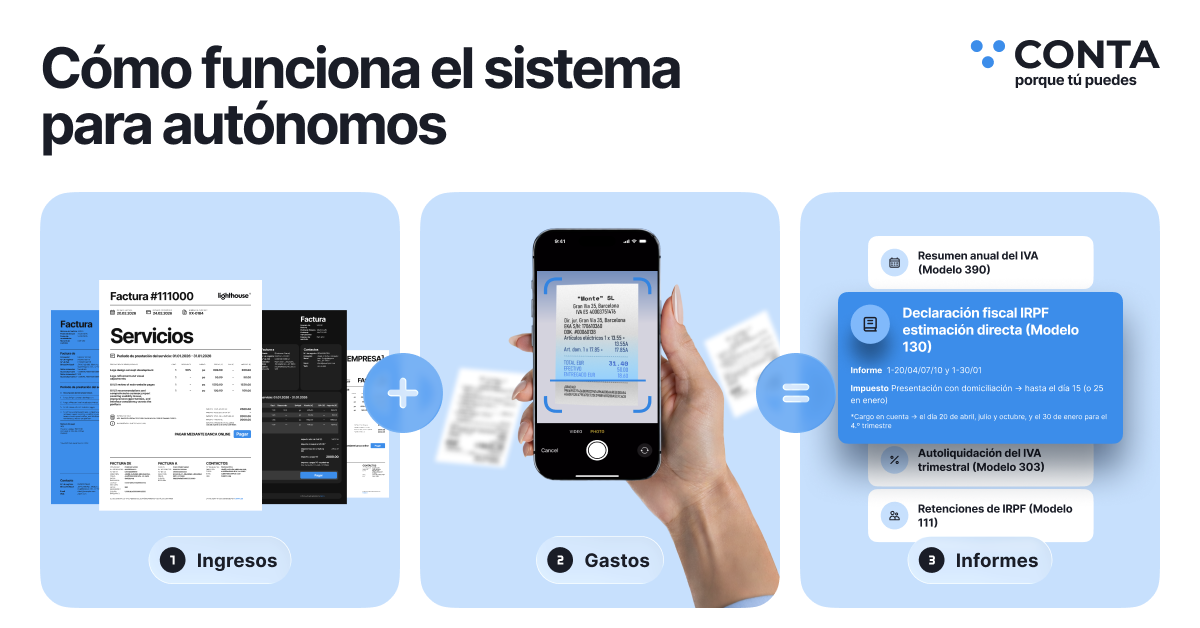
Introduction: why it’s important to know which taxes a self-employed person pays in Spain
Unlike an employee, a self-employed worker in Spain manages their tax obligations directly with the Spanish Tax Agency (Hacienda) and Social Security. There is no company that automatically withholds IRPF for you or pays your contributions on your behalf.
Understanding how VAT in Spain, income tax, contributions and the forms you must file work helps you avoid penalties, calculate whether it really makes sense to become self-employed and plan your cash flow in advance. Throughout this article you will find updated information for tax years 2024–2025, with realistic numerical examples that will help you understand your specific situation in Spain.
This guide is designed as a complete manual for autónomos in Spain: from before registration to the day‑to‑day of taxation, covering all the forms and deadlines you need to know.
Before you start: preliminary steps to become self-employed in Spain
Before paying any taxes in Spain, you must complete a series of essential administrative procedures. Registering correctly will determine how you will be taxed throughout your activity.
Registration with the Spanish Tax Agency (Agencia Tributaria)
Registration in the census of entrepreneurs, professionals and withholders is done using forms 036 or 037. In this process you must:
- Select the heading in the IAE that corresponds to your activity in Spain
- Indicate the applicable VAT regime (general, simplified, recargo de equivalencia, etc.)
- Choose how you will declare IRPF: standard direct estimation, simplified direct estimation or modules
- Decide whether you will apply withholding tax on your invoices
Registration with Social Security (RETA)
Registration in the Special Regime for Self‑Employed Workers (RETA) is mandatory in Spain and must be done at the same time as, or even before, registering with the Tax Agency. Since 2023, the self‑employed contribution is linked to expected net income, which means you will pay more or less depending on what you expect to earn in Spain.
In these initial procedures, the tax framework for your activity in Spain will already be defined, so it is worth taking the time to assess which regime suits you best.
You can find more information about registering as self‑employed in Spain here.
Basic tax obligations of a self-employed worker in Spain
The tax obligations of a self-employed person in Spain are divided into four main blocks:
- Census registration: filing form 036 or 037 with the Spanish Tax Agency
- Periodic taxes: quarterly settlement of VAT and IRPF even if you have low income
- Record‑keeping: obligation to keep books of income, expenses, fixed assets and, in some cases, provisions and advances
- Informative returns: annual summaries and informative forms that the Tax Agency uses to cross‑check data
It is important to clarify that the Social Security contribution for autónomos is not technically a tax, but it is a mandatory monthly payment that must be considered when calculating the total burden a self‑employed worker bears in Spain.
Main taxes a self-employed person pays in Spain: IRPF and VAT
The two key taxes for any autónomo in Spain are IRPF (direct tax on profits) and VAT/IVA (indirect tax on consumption). Both are paid quarterly and then regularised with annual returns.
IRPF for self-employed in Spain: how it works and which forms are used
Personal Income Tax (IRPF) taxes the income obtained from your economic activity in Spain. It is paid partly throughout the year (advance payments) and partly when you file your annual income tax return.
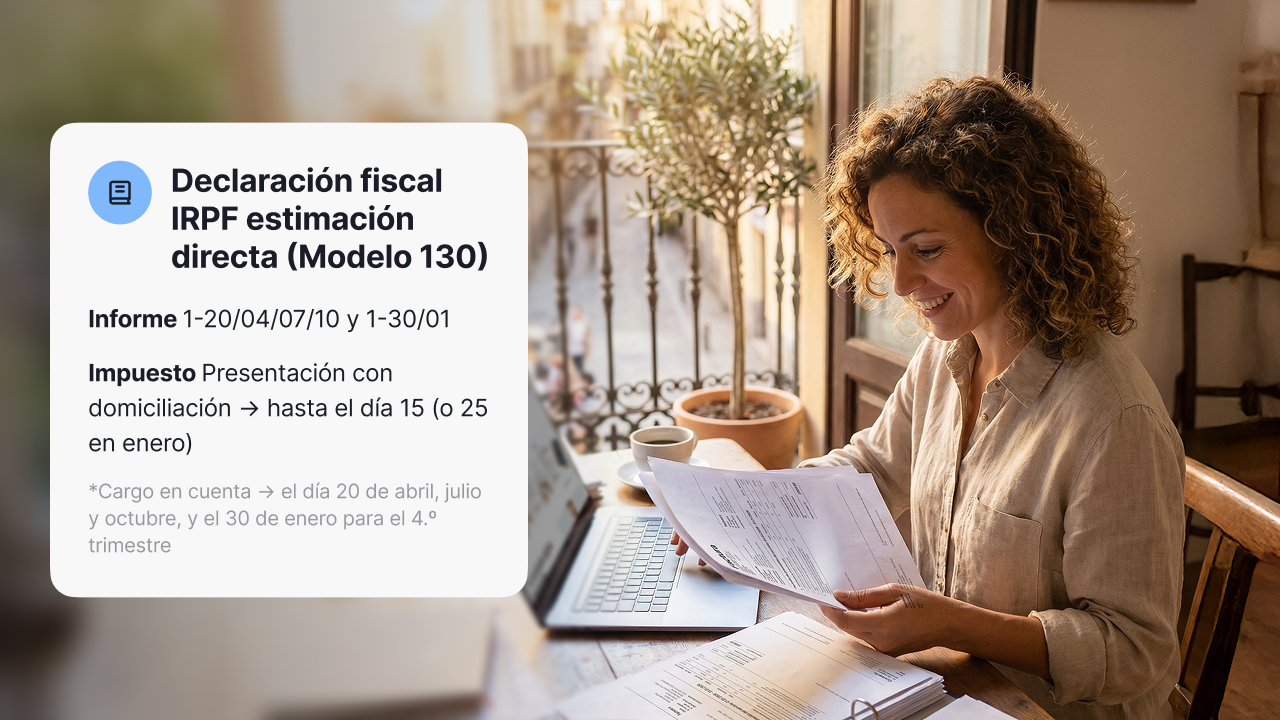
If you are taxed under direct estimation in Spain, you will file form 130 every quarter. The advance payment is 20% of the accumulated net income (income minus deductible expenses).
For example, if in the first quarter you have earned €5,000 and have €1,500 in expenses, your net income is €3,500. The advance payment would be: €3,500 × 20% = €700.
If your activity allows it and you opt for the modules regime in Spain, you will use form 131. Advance payments are calculated according to IAE parameters: size of the premises, electricity consumption, staff employed, etc.
Some professionals in Spain can replace part or all of the obligation to file form 130 by including IRPF withholding on their invoices:
- 7% for new autónomos during the year of registration and the following two years
- 15% as the general rate from the third year onwards
All these quarterly payments are regularised in the annual income tax return (form 100), which is normally filed between April and June of the following year in Spain.
You can find more information about the regimes supported in Conta.es here.
IRPF withholding on invoices in Spain: when it applies and what it means
Certain self‑employed professionals who invoice companies and other professionals in Spain can include IRPF withholding directly on the invoice. The client is responsible for paying that withholding to the Tax Agency via form 111.
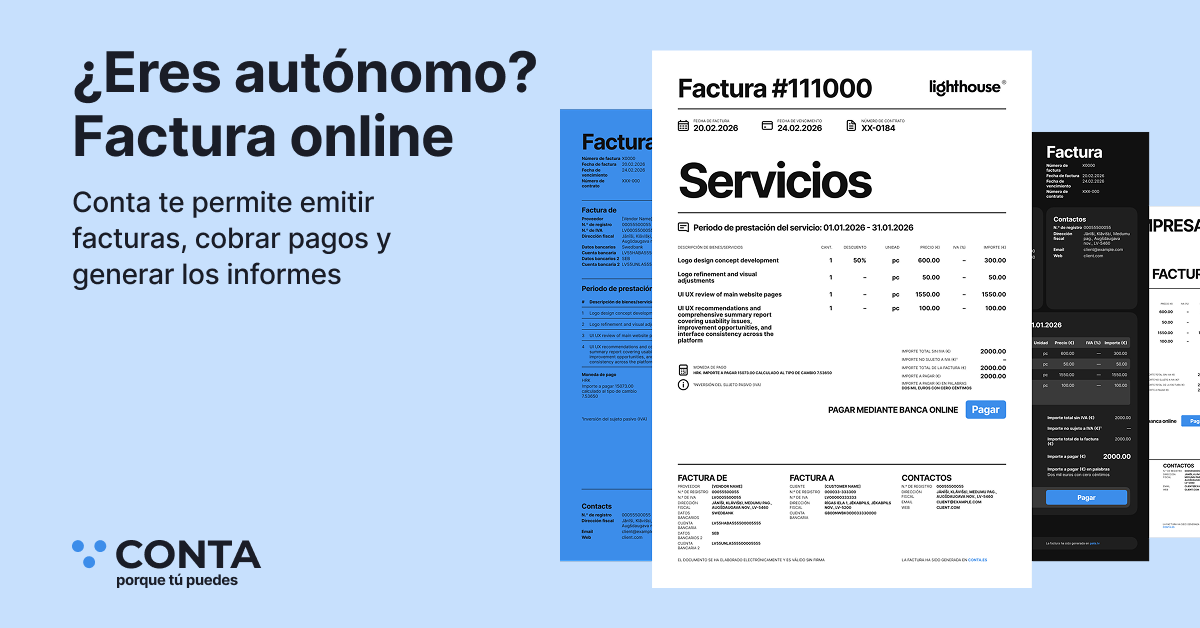
Practical example of an invoice with withholding:
In this case, the client pays you €1,060 and the €150 withholding is paid directly to the Tax Agency in Spain. Those €150 will be deducted from your final IRPF liability when you file your annual return.
If at least 70% of your income carries IRPF withholding in Spain, you may be exempt from filing form 130, although you will still regularise everything in the annual income tax return.
You must apply IRPF withholding on your invoices if your activity is in section 2 of the IAE (professional activities) in Spain.
VAT for self-employed in Spain: rates, calculation and refunds
Value Added Tax (VAT/IVA) is a consumption tax in which you act as an intermediary between your client and the Spanish Tax Agency. You charge VAT to your clients, pay VAT on your purchases, and settle the difference in Spain.
Main VAT rates in Spain (2025):
Calculating quarterly VAT in Spain:
Each quarter you calculate the difference between:
- Output VAT: what you charge on your income invoices
- Deductible input VAT: what you pay on expenses necessary for your activity in Spain
For example, if you invoice €10,000 with 21% VAT, you charge €2,100 in VAT. If your deductible expenses with VAT amount to €6,000 (€1,260 of input VAT), the settlement would be: €2,100 – €1,260 = €840 to be paid in Spain.
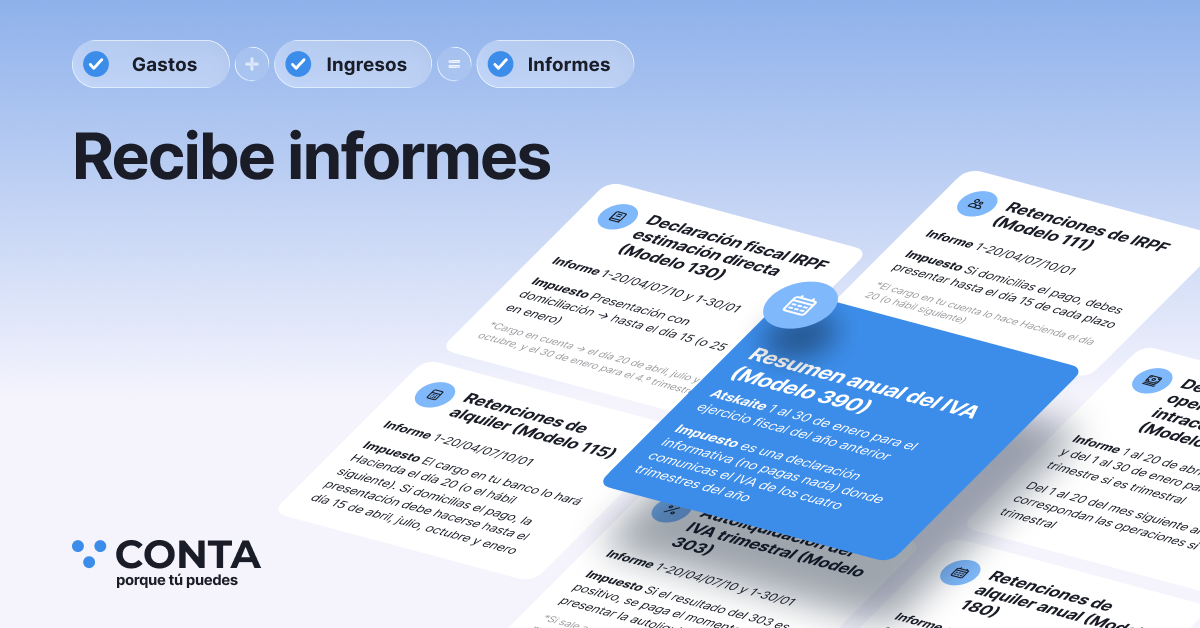
Form 303 is the quarterly VAT self‑assessment in Spain. Additionally, form 390 functions as an annual informative summary for the year.
If input VAT exceeds output VAT, you can request a refund or carry the balance forward to offset future quarters in Spain.
Other payments and taxes that affect a self-employed worker in Spain
In addition to IRPF and VAT, there are other relevant periodic payments in Spain that you must consider to calculate your total burden as a self‑employed person.
Self-employed Social Security contribution
Since 2023, the Social Security contribution in Spain is calculated according to monthly net income. The system establishes 15 bands with contributions ranging from approximately €230 to more than €500 per month in 2025.
Approximate examples of contributions:
The contribution is debited by direct debit on the last working day of each month in Spain and entitles you to benefits such as sick leave, maternity/paternity, retirement and cessation of activity.
The most up‑to‑date and detailed information on self‑employed contributions in Spain can be found here.
Flat rate for new self-employed workers
There is a reduced flat rate of €80 per month during the first year for new autónomos in Spain, which can be extended if income remains low according to current regulations.
IAE and other local taxes
The Economic Activities Tax (IAE) is only paid if your turnover exceeds €1,000,000 per year. Most self‑employed individuals in Spain are exempt from the fee, although they must be registered under the relevant heading from the start.
Some town councils in Spain may have specific fees that affect certain self‑employed workers:
- Public space occupation fees
- Terrace fees (hospitality)
- Commercial waste fees
- Business opening licences
It is advisable to review the municipal regulations where you carry out your activity in Spain to be aware of any additional payments.
Forms and periodic returns filed by a self-employed person in Spain
Taxes for autónomos in Spain are reported through specific forms with defined deadlines. Most of them are filed online via the Electronic Headquarters of the Spanish Tax Agency using a digital certificate, electronic ID or Cl@ve system.
List of the most common forms:
Most common quarterly forms in Spain
The filing deadlines for quarterly tax returns in Spain are:
- Q1: from 1 to 20 April
- Q2: from 1 to 20 July
- Q3: from 1 to 20 October
- Q4: from 1 to 30 January of the following year
Form 130 records the accumulated income and expenses for the year to calculate the 20% advance payment. Form 131 is used for the modules regime.
The quarterly self‑assessment where you declare VAT charged and VAT paid. The result can be payable, to be carried forward or, in some cases, refundable (usually only in Q4 in Spain).
If you have employees or hire other professionals with withholding in Spain, you file form 111. If you pay rent for commercial premises, you file form 115 with the withholdings made.
For trade with companies in the European Union (intra‑EU transactions), this form is filed monthly or quarterly depending on volume.
Annual tax returns and informative forms in Spain
In addition to quarterly forms, there are annual summaries that the Spanish Tax Agency uses to check data consistency.
This is usually filed between April and June. Here you regularise all IRPF advance payments made during the year and determine whether the final result is payable, refundable or neutral in Spain.
This consolidates all VAT information for the year. It must reconcile with the four form 303 returns filed.
Annual summaries of the withholdings declared in forms 111 and 115 respectively.
Annual declaration of transactions with third parties exceeding €3,005.06 per year. It is usually filed in February in Spain.
These returns do not always imply extra payment, but their omission or errors can lead to penalties.
You can find more information about the forms for autónomos in Spain here.
How much tax does a self-employed person really pay in Spain? Practical examples
The effective percentage of tax in Spain depends on net profits, withholdings already made, applicable deductions and your Autonomous Community.
Example 1: Self-employed person with moderate income
Example 2: Self-employed person with high income
In practice, an average self‑employed worker in Spain may face a combined IRPF burden of between 15% and 30% on profits, depending on the tax band and applicable deductions.
VAT in Spain should not be seen as a direct cost if you correctly charge it to clients and properly deduct expenses, although it does affect quarterly cash flow because you often pay it before collecting from clients.
The self‑employed Social Security contribution must always be included in your analysis to calculate your real “net salary” as a self‑employed worker in Spain.
Tips for managing taxes as a self-employed worker in Spain (on your own or with an advisor)
Tax management in Spain can be done independently using online tools or with the support of a professional advisor. Both options are valid and can be combined.
Practical recommendations:
- Keep your bookkeeping up to date, recording income, expenses and invoices so you do not improvise at the end of the quarter in Spain
- Use specialised software or platforms that allow you to issue invoices with correct VAT and IRPF, record expenses and automatically generate the data for official forms
- If your activity is complex (you have employees, rentals, EU operations or a company), consider the support of a professional or agency in Spain
- Review the most common deductible expenses to legally optimise your taxable base in Spain
Common deductible expenses:
- Utilities (electricity, water, internet) proportionally if you work from home in Spain
- Office or coworking rent
- Vehicle (with limitations depending on professional use)
- Marketing and advertising, including your website
- Training related to your activity
- Professional insurance
- Materials and equipment
- Social Security contributions
Common mistakes to avoid in Spain
Most frequent mistakes:
- Not issuing invoices with all mandatory data (NIF, date, description, VAT breakdown)
- Forgetting to file returns in quarters without activity (you still need to file them “with zero” in Spain)
- Mixing personal and professional expenses in the same bank account
- Not keeping receipts and invoices for the legal period (at least 4 years)
Consequences of late filing in Spain:
Filing forms late results in automatic surcharges:
- Up to 3 months late: 5% surcharge
- Up to 6 months: 10%
- Up to 12 months: 15%
- More than 12 months: 20% + interest
If there is a prior request from the Tax Agency in Spain, additional penalties may apply.
Other tips:
- Report changes of tax address, activity or regime using the appropriate census forms in Spain
- Plan your cash flow in advance to prepare for the impact of quarterly payments
- Maintain a separate bank account exclusively for your professional activity in Spain
Frequently asked questions about taxes for self-employed workers in Spain
Do I have to pay taxes if I had no income in a quarter?
Unless you deregister from the census in Spain, you are still required to file forms even if you had no income or expenses. In that case, returns are filed “with zero” and there is nothing to pay.
If you expect a long period of inactivity in Spain, it may be in your interest to deregister from the Tax Agency and Social Security so as not to generate unnecessary obligations or pay contributions without earning income.
Can I combine unemployment benefits with registering as self-employed in Spain?
In many cases in Spain, it is possible to combine unemployment benefits with self‑employment for a limited period (usually up to 270 days), provided certain conditions regarding your activity and income are met.
There is also the option to capitalise unemployment (receive the benefit as a lump sum) to invest in your new business in Spain. Check the updated conditions at SEPE and request compatibility or capitalisation before starting your activity.
Can I change from modules to direct estimation (and vice versa) in Spain?
Yes, you can change your IRPF regime by filing the relevant census forms, usually in December of the year before you want the change to take effect in Spain.
Bear in mind that moving from modules to direct estimation is usually irreversible for several years (typically three), so it is important to assess the tax impact in Spain before requesting it.
What happens if I am late paying the self-employed Social Security contribution in Spain?
Social Security in Spain applies automatic surcharges for non‑payment:
- If you pay in the following month: 10% surcharge
- Longer delays: higher surcharges that can reach 20% plus interest
Continuous delays can cause you to lose benefits such as the reduced flat rate. It is important to regularise the situation as soon as possible in Spain to avoid accumulating debt.
Do I always need an advisor to manage my taxes as a self-employed worker in Spain?
It is not legally mandatory to have an advisor in Spain. Many self‑employed people with simple activities use online tools (such as www.conta.es) and information from the Spanish Tax Agency to successfully manage VAT and IRPF on their own.
However, when your activity grows or becomes more complex in Spain (you hire employees, set up a company, carry out international operations), working with an advisor usually saves time, money and reduces the risk of mistakes that could lead to penalties.
Knowing which taxes a self‑employed person pays in Spain is the first step towards managing your activity with confidence and making informed decisions about your professional life. Whether you decide to handle your bookkeeping independently or work with an advisor in Spain, this guide will serve as a reference for your day‑to‑day work.
If you are considering becoming self‑employed in Spain, use the official Social Security simulators and the examples in this article to calculate your real tax burden before taking the step.
Sign up and try the system for free – the 60‑day trial period will allow you to test all the features and take one more step towards fully managing your own accounting in Spain.